
Company Information
 Member Since 12 Years
 Nature of Business Manufacturer Year of Establishment 2000
Ask for more detail from the seller
Contact Supplier
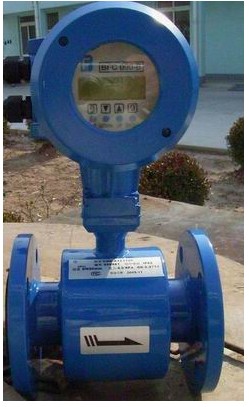
We are offering Water Electromagnetic Flowmeter.
1.1Features
Measurement is not affected by the variation of flow density, viscosity, temperature,
pressure and conductivity. High accuracy measurement is guaranteed according to the
linear measurement principle.
No obstacle in the pipe, no pressure-loss and lower requirement for straight pipeline.
DN 6 to DN2000 covers a wide range of pipe size. A variety of liners and electrodes are
available to satisfy different flow characteristic.
Programmable low frequency square wave field excitation, improving measurement
stability and reducing power consumption.
Implementing 16 bits MCU, providing high integration and accuracy; Full-digital
processing, high noise resistance and reliable measurement; Flow measurement range up
to 1500:1.
High definition LCD display with backlight.
RS485 or RS232 interface supports digital communication.
Intelligent empty pipe detection and electrodes resistance measurement diagnosing
empty pipe and electrodes contamination accurately.
SMD component and surface mount technology (SMT) are implemented to improve the
reliability.
1.2Main Applications
WELTER electromagnetic flowmeter can be used to measure the volume flow of
conductive fluid in a closed pipeline. It is widely applied in the flow measurement and
control in the fields of chemical and petroleum industry, metallurgy industry, water and
waste water, agriculture and irrigation, paper making, food and beverage industry and
pharmaceutical industry.
1.3Ambient Conditions
Ambient temperature: sensor: -25C to + 60C; converter: -25C to + 60C.
Relative humidity: 5% to 90%;
1.4Working Conditions
Maximum fluid temperature:
Compact type: 60C
Remote type: Teflon 150C
Neoprene 80C; 120C
Polyurethane 70C
Fluid conductivity: 5μS/cm
2. WORKING PRINCIPLES
2.1 Measuring Principles
The measuring principle of electromagnetic flowmeter is based on the electromagnetic
induction law of Farady. The sensor is mainly composed of measuring tube with isolate lining, a
pair of electrodes installed by penetration of the measuring tube wall, a pair of coils and iron core
to produce working magnetic field. When the conductive fluid flows through the measuring tube
of the sensor, the voltage signal in direct proportion to the average flow velocity of the fluid will
be inducted on the electrodes. The signal is amplified and treated by the transmitter to realize
various display functions.



Connect with us





 For Buyer
  For Seller
  Help
Help 
 Asian
Asian 
 Send Enquiry