Our Products
We are leaders in the market for providing best range of ECCENTRIC SCREW PUMPS / PROGRESSIVE CAVITY PUMPS, Twin Screw Pumps, TRIPLE SCREW PUMPS / THREE SCREW PUMPS, Rotary Lobe Pumps and Twin Screw Pump
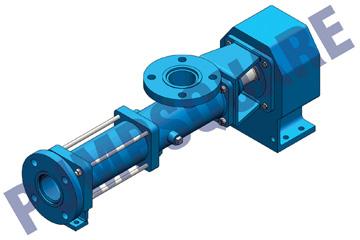
The progressive cavity pump is a positive displacement rotary pump. The actual pumping elements of the pump are the rotor and the stator. The single helical rotor rolls eccentrically in a double threaded helix stator of twice the pitch length. A series of sealed cavities 180, part are created that progress from suction and to discharge end. The opposing cavities fill and empty simultaneously resulting in a pulsation free flow. The fluid travels axially with relatively low velocity and minimal agitation of the fluid. This Pump has the Capability to transfer the liquid without Shear and no Churning of the Liquid takes place during Pumping. The stator is made of a resilient elastomers material and vulcanized to the stator tube providing a slide radial interference of the rotor in the stator. The important feature of the pumping principal is the ability to handle slurries and solid particles. The elastomers stator adds abrasion resistance beyond that of conventional rotary pumps. The particles tend to imbed rather than abrade the elastomers stator also allowing deformation to partially accommodate the solid particles. The compression fit of the rotor and stator enables the Progressive cavity pumps to handle gaseous liquids and low viscosity liquids. The pressure capabilities of the pump are a function of the nurnber of times the progressive seal lines are repeated. Our progressive cavity pumps are available in 1, 2, and 4 stage design. Each stage has a maximum pressure lirnit of 6 Bar. This pumps are available in a wide variety of materials and can be easily customized as per the fluid compatibility and requirements. Our progressive cavity pumps are versatile, rugged, compact and highly efficient.
If the fluid is delicate, shear sensitive or abrasive, low or high viscosity, with fibers, high air content, or large solids, our progressive cavity pumps can solve the problem of moving the fluid. Pumps are available for Discharge pressure upto 24 Bar, flow upto 5000 LPM, temperature upto 150C.
SPECIAL FEATURES :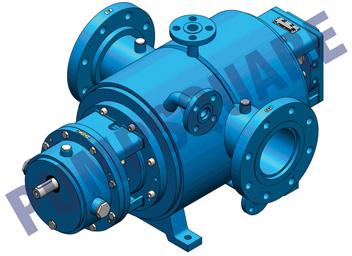
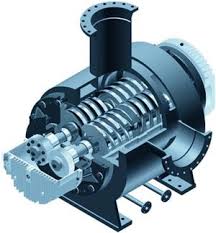
PUMPSQUARE Twin Screw Pumps are designed for pumping contaminated or slightly abrasive liquid, lubricating and non lubricating media of low or high viscosity which do not chemically attack the pump materials. These are double entry pumps and the shaft spindle is axially held in position by ball bearings. Single unbalanced mechanical seal is used keeping the liquid pumped isolated from the bearings and gearbox. A spring loaded built in relief valve is used to protect the pump from overloading
Option Heating and Cooling Jacket.
Option of Horizontal and Vertical Mounting
APPLICATIONS :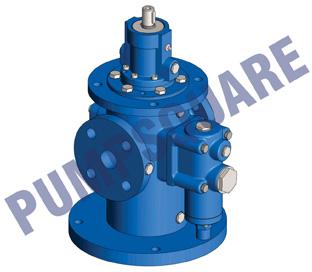
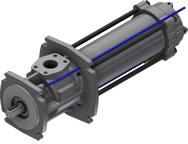
Triple Screw Pumps are positive displacement pumps of very simple design They consist of three rotating parts only the rotors" which turn in their precisely machined housing bores. The rotors are of double start screws, continuously meshing to form delivery chambers, which move constant y from the suction to the pressure / discharge side. Constant volume oi the chambers and the uniformity of the movement allow an even flow The pumps remain therefore near silent in operation and almost free of pulsation, even at high speed The Principle of screw pump and its accurate profiles warrant high suction power. Axial loads on the rotor are compensates by adequate design of the bearing part. All the radial loads are self-compensated.
APPLICATIONTriple Screw Pumps, type TH are used for die transfer of fluids with lubricating properties, as well as for generating pressure in hydraulic units or overcoming pressure in the hydraulic circuits. Main Industrial uses are in:
All kind of Bunker Oil, Engine oil, Furnace oil, Heating oil, Hydraulic Oils, High Viscosity Lubrication Oil, Mineral oil, Synthetic Oil, 0il Water Emulsions and Fuel 0ils, Diesel Oil, LSHS, LDO.
MATERIAL OF CONSTRUCTIONThe pumps here described may be incorporated in various housings and supplied as Foot, Flange or Pedestal Pumps. We also supply cast or welded housings to your specifications. To adapt the pumps to various applications, they can be fitted with the following seal variations:
Upto 120 bar are admissible.
INSTALLATIONScrew-Pumps work perfectly in any position, provided suction and pressure lines are arranged in a way that prevents emptying of the pump when at a standstill.
DIRECTION OF ROTATIONClockwise from the Shaft End of the Pump (Standard)
Anticlockwise from the Shaft End of the Pump (On Request / Non Standard)
DRIVEIn general the pumps are connected with a flexible coupling to a foot or flange mounted motor. Radial loads onto the shaft end are not permissible, unless when absorbed by an additional external bearing, e.g. in case of pump drive by belts or gears.
SPEED OF ROTATIONShaft Speed Ranging from 500-3600 RPM
Do not exceed 1500 RPM when pumping residual fuels, crude oil due to the presence of abrasives and contaminants.
VISCOSITYNormal range 21, 5 to 385 cSt. Depending on type, pressure, speed and suction conditions, fluids with viscosities ranging from 6 to 3800 cSt may be pumped. Regarding viscosities outside the normal range.
Please consult us!
TEMPERATURE RANGEWhen fitted with standard radial shaft seals, up to 90 Deg C. Depending on operating conditions, temperatures as high as 180 deg C are permissible.
Please ask us!
Cooling Jacket & Heating Jacket for the pump body & covers can be provided for easing the cold start of the pump and for continuously pumping liquids at high temperature.
SUCTION LIFT OR INLET PRESSUREFor speed between 1000 and 1700 r.p.m and viscosities below 385 cSt you may reckon with an absolute manometric suction lift of maximum 0, 5 bar. For other speeds or viscosities. Please contact us!
The inlet pressure should not exceed +0, 5 bar, when radial shaft seals are used. For higher inlet pressures we offer gland packings or mechanical seals. If the suction lift condition exceeds the pump capability, cavitation will occur resulting in noise and possible pump damage.
SUCTION AND PRESSURE LINESThe cross section of the suction line should be such that fluid velocity nowhere exceeds 1 m/sec. In the pressure line velocity should not exceed 5 m/sec.
PRESSURE RELIEF VALVEAll housings described here may be obtained with or without pressure relief valve, which we supply at your option as by-pass valve, connected to the suction chamber, or as return valve, conducting the fluid by a separate connection to the tank. When a larger quantity should have to pass through the valve for more than 10 seconds, a return valve has to be fitted, to avoid an undue rise in temperature.
FILTRATIONThe pumps must be protected against solid particles in the fluid by suitable suction filters. The mesh width should be 0.1 mm and care has to be taken that even with a contaminated filter the admissible suction lift capability is not exceeded.
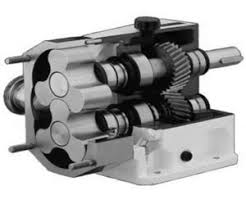
Used with low-viscosity fluids such as LSMGO and light gas oils with standard viscosities between 1.2 cSt and 10/15 cSt, typically used with Boiler systems with pressures up to 40 bar and flow rates of 560l/min (33.6m3/h). Its high self-priming strength and its capacity to operate at low viscosities make it very a suitable pump for applications with fluids that do not include lubricating properties among its main characteristics.
 Chintan Turakhia (Pumpsquare Systems LLP)
 No. 228, Wadala Udyog Bhavan Naigaon Cross Road, Wadala, Mumbai, Maharashtra - 400031, India
 Share us via