Write a Review
Our Products
We are leaders in the market for providing best range of Dancing LED Circuit Board and Dancing LED Using Transistors DIY Kits
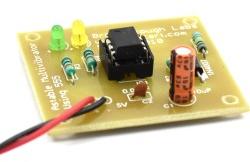
Astable Multivibrator circuit is a simple multivibrator which has no stable state. It has two LED, which will flashing with a time period. NE555 oscillator is used for generating the free running waveforms whose output will be adjustable by varying the external RC network.
NE555 is a Timer IC, which is connected in an astable multivibrator mode. In NE555, 8thpin & 1stpin is connected to Vcc & Ground. The 4thpin is Reset pin which is active low and is connected to Vcc to avoid accidental resets. 5th pin is the Control Voltage pin which is not used, so to avoid high frequency noises it is connected to a capacitor C2 whose other end is connected to ground. Usually C2 = 0.01F. The Trigger (pin 2) and Threshold (pin 6) inputs are connected to the capacitor C1 which determines the output of the timer. 2nd& 6thPin are connected together allowing the circuit to re-trigger itself. During each cycle, capacitor C1 charges up through both timing resistors, R1 and R2 but discharges itself only through resistor, R2 as the other side of R2 is connected to thedischargeterminal, pin 7. Finally circuit works as a free running multivibrator. It has astable outputs (Pin 3). Diode 1N4007 is used for preventing the negative voltages while discharging the Capacitor C1. In Output, If LED1 is ON then LED2 is OFF and vice versa.
t1=0.693(R1+R2)C1 (Capacitor charging time)
t2=0.693R2C1(Capacitor discharging time)
T=t1+t2(Total time period)
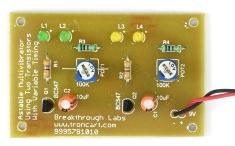
An Dancing LED using Astable Multivibrator is a simple hobby circuit which has no stable states. Its output oscillates continuously between its two unstable states without the aid of external triggering. The time period of each states are determined by Resistor Capacitor ( RC ) time constant.
When the circuit is switched on one transistor will driven to saturation (ON) and other will driven to cutoff (OFF). When a transistor is ON, its collector and emitter act as a short circuit. But when it is OFF they acts as open circuit. So in the above circuit when a transistor is in OFF state its collector will have the voltage Vcc and when it is ON its collector will be grounded.Consider Q1 is ON and Q2 is OFF. During this time Capacitor C2 is charging to Vcc through resistor R2. Transistor Q2 is OFF due to the negative voltage from the discharging capacitor C1 which is charged during the previous cycle. After a time period the capacitor C1 discharges completely and starts charging in reverse direction through R1.When the Capacitor C1 charges to a voltage sufficient provide base emitter voltage of 0.7V to the transistor Q2, it turns ON and capacitor C2 starts discharging. The negative voltage from the capacitor C2 turns off the transistor Q1 and the capacitor C1 starts charging from Vcc through resistor R and base emitter of transistor Q2. Thus the transistor Q2 remains in ON state. As in the previous state, when the capacitor C2 discharges completely it starts charging towards opposite direction through R2. When the voltage across the capacitor C2 is sufficient to turn ON transistor Q1, Q1 will turn ON and capacitor C1 starts discharging.This process continuous and produces rectangular waves at the collector of each transistors.
As a result Output LEDs flashing with charging & discharging time period.
T1=0.693R1C1
T2=0.693R2C2
 Tachlog Pvt Ltd (Tachlog Pvt Ltd)
 Tachlog Pvt Ltd , -, Thiruvananthapuram, Kerala - 695004, India
 Share us via