All solid fuel fired boilers call for a suitable Air Pollution Control Device due to a high ash content. So Thermodyne provides you the Dust Collectors. During combustion, ash deposed of in several ways,
The large agglomerates range from fused lumps to the relatively small particles falling through the bars in to the ash pit or carried forward into the ash pit by some form of moving grate.
Deposit on internal surfaces, and
Small particles entrained in the flue gas stream, some to be rejected into the atmosphere.
The ash content varies from fuel to fuel and thus different designs of equipments are available for effective pollution control. These are called Dust Collectors since they are used to separate out and collect the dust or ash from the dust laden exhaust gases of the boiler. They are generally placed before the ID fan & chimney and thus also help to prevent corrosion of ID fans due to ash. The methods of separating the dust from the flue gases are:
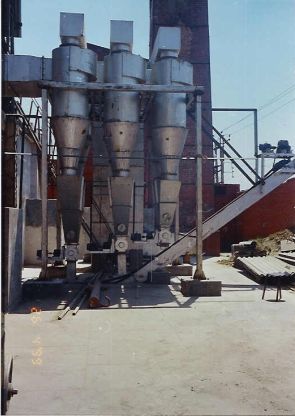
Cyclone Or Centrifugal Collectors: -
This is the simplest type of collector. The cyclone relies upon the centrifugal force imparted to the gases by rotation within the cyclone to separate out the dust. Wide ranges of variations of the basic cyclone exist and are still in the process of development. The gas temperature at which a cyclone collector can operate is limited only by the material of construction, usually mild steel. The cyclone structure should be insulated to avoid condensation of the acid and moisture in the flue gas, which can lead to clogging at low temperatures.
Electrostatic Precipitators: -
These operate by charging the dust particles as the dust-laden gas passes across electrically charged wires. The dust is then attracted to and collected on, oppositely charged plates, which are periodically mechanically rapped or vibrated to remove the dust adhering to them. To achieve optimum collecting efficiency the velocity of the gases through the precipitator must be uniform across the flow path, and this requires careful design of the inlet and outlet ducting.
Precipitators tend to be large and expensive when compared with most other collectors but they can achieve high collection efficiencies with fine materials.
Fabric Or Bag filters: -
These consist of a series of woven fabric bags arranged in parallel on the gas side, through which the gases pass leaving the dust retained on the bag material. The dust is removed by periodic vibration or shaking of the bags. Due to the non-availability of suitable economic bag material, the maximum operating gas temperature is limited to about 260 Deg. Centigrade.The gas pressure drop across a bag filter tends to be high, and increase as the deposited load on the bags increases.
Gas Scrubbers: -
These are devices in which the dust-laden gas stream is brought into contact with the water spray. There are medium and high-energy types, the efficiency of mixing of the water and gas being a measure of the energy used and also of the collection efficiency of the scrubber. Depending upon the gas inlet temperature, gas scrubbers increase the volume of gas discharged to the atmosphere due to the volume of water evaporated, this can result in a visible plume at the chimney discharge even though there is a minimal solids content. This is often mistaken for smoke and hence dust emission.
Combined Collectors: -
The aforementioned types of collector can be used in combination to achieve the desired emission levels, e.g. precipitators may be preceded by mechanical cyclones to remove the larger dust particles. There have been occasions when a high-efficiency bag filter has been used on the gas side in parallel with a mechanical cyclone, where the latter cannot alone achieve the design emission level and a bag of adequate size is too bulky and expensive. The proportion of gas flowing through each is selected to give the desired combined efficiency. Such a combination can give a lower capital cost scheme than a bag filter only. This procedure can be use as a retrofit, where the design emission has not been achieved by the originally installed cyclone or where the fuel conditions have changed, thus necessitating a higher collecting efficiency to achieve the desired emission etc.
 Ashwani Setia, Rohit (Thermodyne Engineering Systems)
 A-7/110, Ssgt Road Industrial Area, Vijaynagar, Ghaziabad, U.p.-201009, Vijay Nagar, Uttar Pradesh
 Share us via







 Write a Review