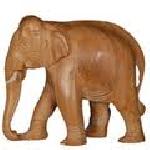
Wood has been used for making articles of utility as well as artistic nature since time immemorial. India exhibits the tradition of exquisite natural breathtakingly beautiful wooden handicrafts.The country's vast cultural and ethnic diversity has enabled a variety of motifs, techniques and crafts to flourish in various parts of the land. India possesses a tradition of elaborate woodwork for both utilitarian and architectural purposes.
India's fertile soil causes all types of trees to grow in abundance - which become an unlimited source for the basic raw material needed in this craft -woodcraft. The woods used for ornamental work in India are Walnut, and Sandalwood, with its delicate natural fragrance is used in Mysore and a few other places in South India. Sal, Teak, Sheesham, Deodar, Redwood, Rosewood, Red Cedar, Ebony to name a few are extensively used by Indian craftsmen, as they focus on the fine decorative carving and inlay work.
A sculpture, figure or figurine may be formed out of working wood by means of a cutting or carving tool. Some of the basic tools are carving knife, a gouge, the chisel, a mallet, v ad u shape tools and of course the grained or sand paper. The scope of carving depends on the nature of the wood. Hardwoods have a longer life and lust. Softer wood is easier to carve. Natural oils of walnut and linseed are used to polish the complete pieces to protect them from lust and moisture.
The artists and master craftsmen found wood to be a highly useful and convenient medium. Wood was something on which the carvers could pour forth their ideas about mythology, legend and folklore and even emotions because wood could be easily preserved for posterity.
Over the centuries, each region in India developed its unique style of wooden structures, carvings and inlay work. the states of Jammu and Kashmir, Uttar Pradesh, Gujarat, Karnataka and Kerala figure on this list. More..

 GST : 29AJSPK7589B2ZH
 Write a Review
 Yuvarajh Kurtkoti (Blucrafts)
 247, Ranade Road, Shivaji Colony, Tilakawadi,, Belgaum - 590006 Karnataka, Tilakwadi, India
 Share us via