
 GST : 24AANCS9768F1ZQ
 Write a Review
Our Products
We offer a complete product range of Fluid Bed Top Spray Granulation and High Shear Granulation
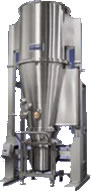
Granulation is one of the most important unit operations in the production of pharmaceutical oral dosage forms. However, there are many different technologies each having different strengths and weaknesses.
Granulation methods:
The fluid bed granulation process also known as agglomeration involves suspending particulates in an air stream and spraying aliquid from the top down onto the fluidized bed. Particles in the path of the spray get slightly wetted and become tacky. The tacky particles collide with other particles and adhere to them to form a granule.
Granulation can be performed using fluid beds fitted with spray nozzles. It is possible to have completely closed material handling by a closed linking with upstream and downstream equipment. Also, fully automatic cleaning in fluid beds using stainless steel filters now compares favorably with what is possible in a single pot. There are two different modes of fluid bed granulating:
Dry Stage:In Dry stage granulation, the particles only require a slight wetting to become tacky and stick to each other. The granulating solution is applied at a rate less than or equal to the evaporation rate. Thus the particles remain "dry" through the entire process.
Wet Stage:In Wet stage granulation, the particles require significant wetting before they become tacky enough to stick to each other. The granulating solution is applied at a rate higher than the evaporation rate until the particles build up enough moisture to granulate. The characteristics of the particles when wet and the type of granulating solution being used will determine which mode of granulating is most appropriate. While Dry stage is more common, Wet stage granulating allows for denser products.
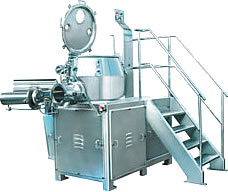
The system allows full integration with upstream and downstream equipment, and even includes a wet mill between thegranulator and dryer. With modern control systems it is easy to load, mix and granulate a second batch in the high shear granulator whilst drying the previous batch in the fluid bed prior to discharge. All equipment can be CIP in a single automatic process. Where as a single shaker might be acceptable for drying application. A twin shaker or blow back filter should be used for granulation processes.
 Shree (Shree Bhagwati Machtech India Pvt Ltd.)
 9/A, Bhagyoday Estate, Ajod Dairy Road, Rakhial, Industrial Area, Ahmedabad - 380 023. Gujarat - 380023
 Share us via