 Write a Review
Our Products
Our product range contains a wide range of Forced Circulation Evaporators, Falling Film Evaporators, Rising Film Evaporator and Multi Effect Evaporators
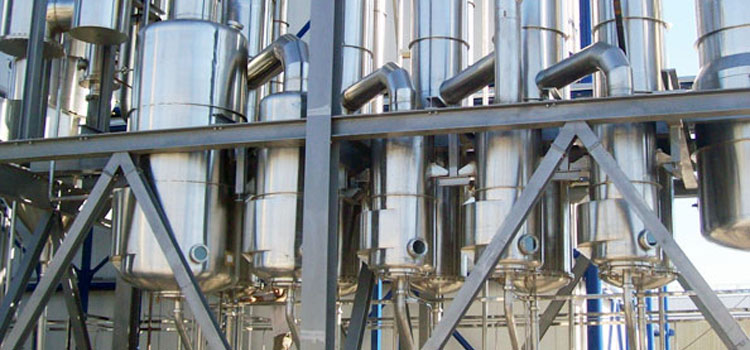
These types of evaporators are recommended for the concentration of high viscosities solutions/slurries which have a tendency to crystallize or produce scales.
The circulating product is heated when it flows through the heat exchanger and then partially evaporated when the pressure is reduced in separator. The liquid product is typically heated only a few degrees for each pass through the heat exchanger.
This type of evaporator is also used in crystallization applications because no evaporation and therefore no concentration increase, takes place in the heat transfer surface. Evaporation occurs as the liquid is flashed evaporated in flash vessel/separator.
Advantage :
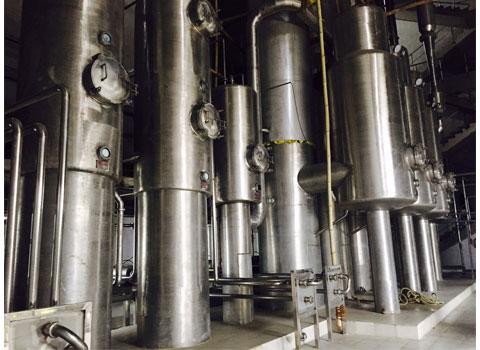
The falling film evaporator consists of shell and tube heat exchanger called as calandria that is mounted in vertical position. The liquid product enters the evaporator at the head and is evenly distributed to the heating tubes.
A thin film enters the heating tube and flows downwards at boiling temperature through the steam in the jacket and is partially evaporated.
The vapour is separated from the liquid in vapour separator and the concentrated liquid is collected at the bottom or transferred to the next stage.
The falling film evaporators can be single effect or multiple effects depending on the capacity.
Falling film evaporators can be operated with small temperature differences between the heating media and the boiling liquid and they also have short product contact time. These characteristics make the falling film evaporator particularly suitable for heat sensitive products and it is the most frequently used evaporator.
Advantage :
Applications :
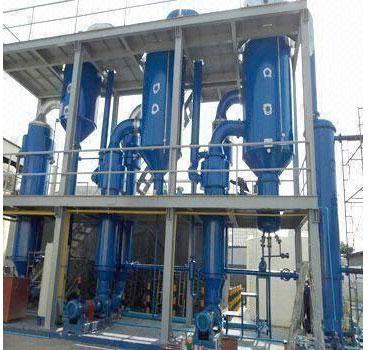
Rising film evaporator operate on a "thermo-siphon" principle. Feed enters at the bottom of the heating tube and as it heats, steam begins to form. The ascending force of this steam produces during the boiling causes liquid and vapours to flow upwards in parallel flow. At the same time the production of vapour increases and the product is pressed as thin film on the walls of the tubes and rises upwards. This co-current upward movement against gravity has the beneficial effect creating a high degree of turbulence in the liquid which is advantageous during evaporation of highly viscous products and for the products that have tendency to foul during heating surfaces.
These types of evaporators are often used with product recirculation, where some of the formed concentrate is reintroduced back to the feed inlet in order to produce sufficient liquid loading inside the heating tubes.
Advantages :
Applications :
 B. Kannan (Nsi Equipments Pvt. Ltd)
 734, Anna Salai, Chennai - 600 006, Tamil Nadu - 600006, India
 Share us via








