


Company Information
 Member Since 14 Years
 Nature of Business Retailer Year of Establishment 2012
Ask for more detail from the seller
Contact Supplier
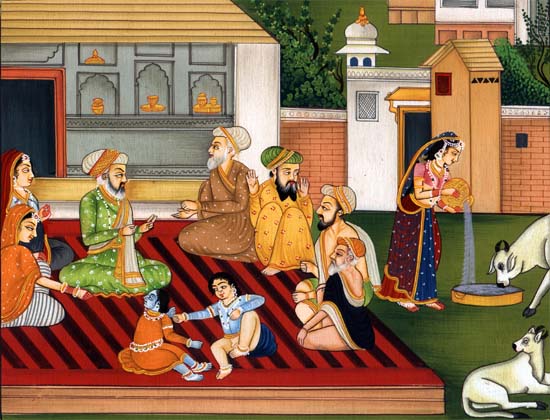
Guler State was famous as the cradle of the Kangra paintings. Guler style painting constitutes the early phase of Kangra Kalam. About the middle of the eighteenth century some Hindu artists trained in Mughal style sought the patronage of the Rajas of Guler in the Kangra Valley. There they developed a style of painting which has a delicacy and a spirituality of feeling. The drawing in Guler painting is marked by liquid grace and precision. The colours which emphasize cool blues and greens are handled with skill. Guler artists had the colors of the dawn and the rainbow on their palette.
Of the hill states Guler has the longest tradition in the art of painting. During the rule of Raja Dalip Singh (1645–1743) artists were working at Haripur Guler. However it was during the reign of Govardhan Chand (1743–1773) that an active school of painting developed at Haripur Guler. There are numerous portraits of this Raja in the Chandigarh Museum.[5] Govardhan Chand's son Prakash Chand (1773–1779) continued the patronage of artists. His son Bhup Chand (1790–1826) also had artists working under him. Painting in Guler continued right up to the close of the 19th century.
The art of Guler style painting flourished in families with distinguishable styles and techniques, most significant amongst them were that of Pandit Seu of Guler, who died in about 1740, and his sons, the remarkable Nainsukh and Manaku. Later while Manaku worked at Guler, Nainsukh migrated to Jammu.



Connect with us





 For Buyer
  For Seller
  Help
Help 

 Chamba, Himachal Pradesh
 Send Enquiry