
Company Information
 Member Since 9 Years
 Nature of Business Manufacturer
 GST No. 07AAHFI6568G1Z2
Ask for more detail from the seller
Contact Supplier
Features:
Applications:
Principle Of Operation:
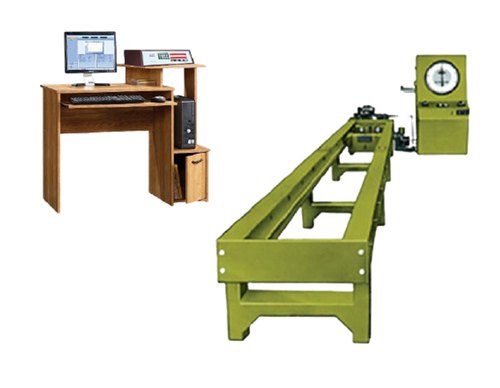
Operation of the machine is by hydraulic transmission of load from the test specimen to a separately housed load indicator. The
hydraulic system is ideal since it replaces transmission of load through levers and knife edges, which are prone to wow and damage
due to shock on rupture of test pieces.
Load is applied by a hydrostatically tubricated piston Main cylinder pressure is applied to specimen through a load cell which senses
load. Displacement of the piston is transferred to a rotary encoder through rack & pinion arrangement. Load cell & rotary encoder
signals are processed in microprocessor based measuring panel where load & displacement are indicated digitally. Return
movement of the pendulum is effectively damped to absorb energy in the event of sudden breakage of a specimen
Control Panel:
The controt panel consists of a power pack complete with drive motor and an oil tank, control valve, and electronic measuring panel.
Power Pack:
The unit generates a maximum pressure of 200 kgf / cm2 The hydraulic pump provides continuously non-pulsating oil. Hence the
load application is very smooth.
Hydraulic Controls:
Measuring Systems:
Measuring system of these machines consists of a precision load cell for measuring load, a rotary encoder with rack and pinion
arrangement to measure displacement and a microprocessor panel to indicate load and displacement digitally. The panel provides
membrane key board to tare load and reset displacement instantly by touch of key. Test resutts like peak load, displacement at peak
load and displacernent at rupture U.T.S., % elongation etc. are available on panel
RS-232C Serial interface is provided to transfer test data to computer. Window based software is available optionally to provide real
time plot and data storage on PC.
Accuracy And Calibration:
Di\\\'s Electronic Horizontal Chain and Rope Testing Machines are closely controlled tor sensitivity, accuracy and calibration during
every stage of manufacture. Every Machine is then calibrated over full range in accordance with British Standards 1610-1964 and
IS 1828-1975.



Connect with us





 For Buyer
  For Seller
  Help
Help 

 Indraprastha Extension, Delhi


 Send Enquiry