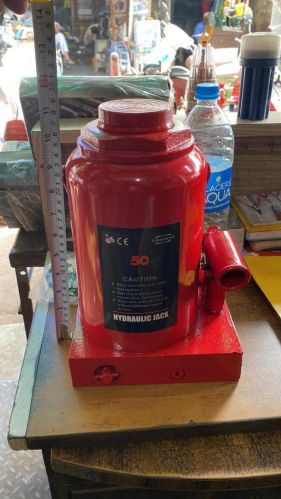
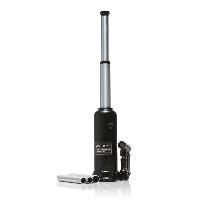
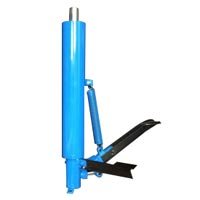
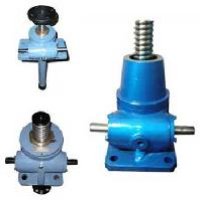
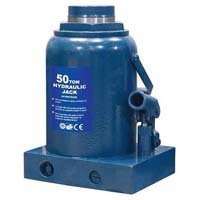
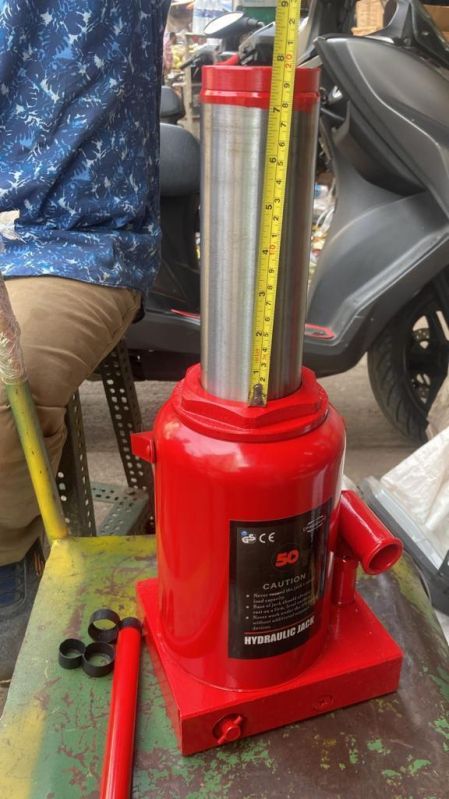
A hydraulic bottle jack is a mechanical lifting device that uses hydraulic pressure to lift heavy loads, typically vehicles. It's named "bottle jack" because of its cylindrical, bottle-like shape.
How It Works:
The jack uses Pascal’s Principle, which states that pressure applied to a confined fluid is transmitted equally in all directions. Here's a simplified process:
- Pumping the Handle: You manually pump a handle, which moves hydraulic fluid (usually oil) from a reservoir into a cylinder.
- Building Pressure: As the fluid moves into the cylinder, pressure builds and pushes a piston upward.
- Lifting: The upward movement of the piston raises the lifting pad, and whatever is on it (e.g. a car).
- Lowering: To lower the load, a release valve is opened, allowing fluid to flow back into the reservoir.
Main Components:
- Base: The bottom part that provides stability.
- Hydraulic Cylinder: Where the fluid pressure builds.
- Piston/Ram: The lifting arm that extends out of the cylinder.
- Handle: For manual pumping.
- Oil Reservoir: Stores the hydraulic fluid.
- Release Valve: Allows controlled lowering of the jack.
Common Uses:
- Lifting cars or trucks during maintenance.
- Supporting loads during construction or repairs.
- In industry for pressing, bending, or straightening applications.
Pros:
- High lifting capacity.
- Compact and portable.
- Simple to operate and maintain.
Cons:
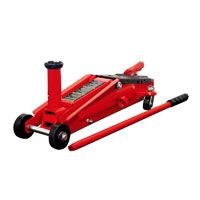
- Limited vertical lift range compared to floor jacks.
- Must be used on a solid, level surface for safety.
- Slower operation due to manual pumping.
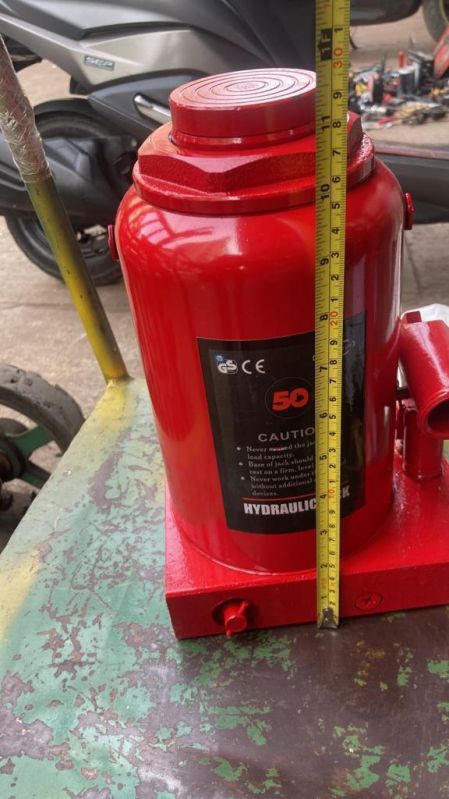
 999 / piece Get Latest Price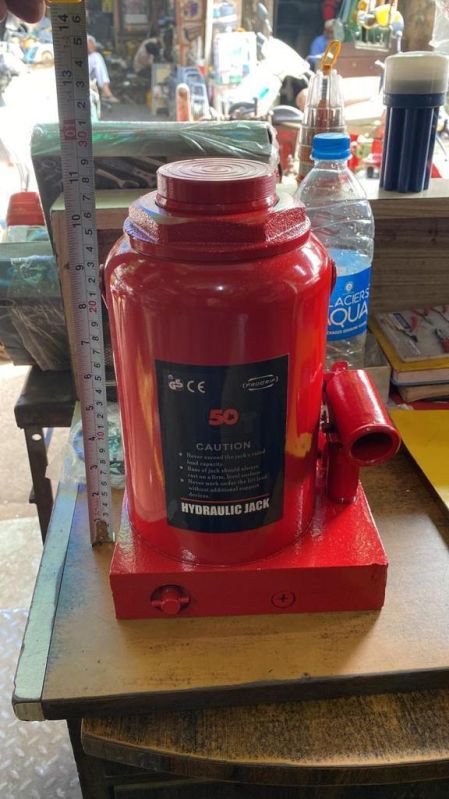


 Member Since 4 Years
 Nature of Business Exporter
 GST No. 27AECPT4419C1ZN
  Address 10, Tarwala Building, Stable Street Nagpada, Mumbai, Maharashtra, 400003, IN






 For Buyer
  For Seller
  Help
Help 
 Twitter
 WhatsApp
 Facebook
 Linkedin