
Company Information
 Member Since 8 Years
 Nature of Business Retailer
Ask for more detail from the seller
Contact Supplier
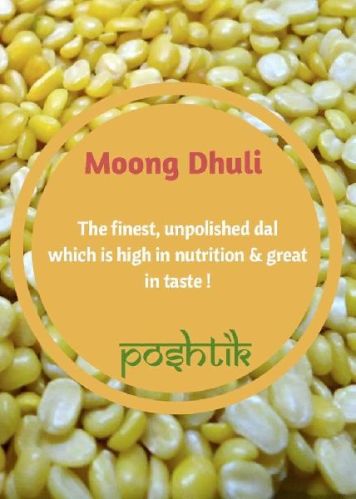
Green gram or moong dal is one of the best vegetarian superfoods. Amongst various nutritients, Moong dal is a rich source of Vitamin A (Beta-Carotene) compared to other lentils. 100gms of Moong Dal offers as much as 50% of daily requirement of essential minerals such as iron and magnesium. Magnesium promotes muscle and nerve function and help build strong bones.
Moong dal Chilka (split) and dhuli (skinned) are both extremely light and easy to digest. It is easier to cook but lacks the fiber content of whole green moong. Compared to other dals, moong dal is one of the low carb pulses available.
Now all 3 Moong Dhuli variants available at poshtik.in
The practice of polishing pulses (or for that matter other food products like rice, sugar, etc.) has its origin in the desire to improve its keeping quality, and over time an established demand for good appearance. Unfortunately, the aesthetic sense is appealed to in greatest measure in this case by the product of lowest nutritive value.
Polishing, though not recommended, is done primarily for second and third grade dal. Dobious quality oil, colour and marble powder are used to improve appearance and price of the product. Commonly leather belts are used for rubbing dal against the screen to give shine and uniform look.
The advantages and disadvantages polished dals?
Here’s a simple list:
Key Advatanges
Disadvantges
How are dals polished?
After undergoing the standard pre milling treatment such as cleaning, sorting, de-husking, sliptting, etc., the pulses are polished to increase consumers appeal, though not desirable. Dal is polished in different ways, such as nylon polish, oil/water polish, leather and makhmal polish. Generally polishing is done in large commercial machines using marble stone powder, oil or water. Polishing gives uniform look and shine to each grain.
What are the big benefits of consuming unpolished dals?
No polish means to get closest to real natural dal without being subjected to undesired polishing process and chemical adulterants into your diet. Pulses are very high in fibre. They contain both soluble and insoluble fibres. Soluble fibre helps lower blood cholesterol levels, while insoluble fibre helps with digestion as well as maintaining regular bowel movements. Polishing processes severely reduce the fibre content of your dal.
Why should I consume Poshtik Dal ?
Arhar dal is not polished and hence all nutrients are preserved. They are grown in areas which have traditionally grown the best dals you could get – Maharashtra, Madhya Pradesh & Karnataka.Poshtik™ sources only wholesome varieties of dals from various parts of the country. Our dals are superior for the following reasons:
Poshtik™ dals are very similar to how our grandparents consumed pulses.
Why are unpolished dals more expensive?
Unpolished dals are costlier since there is little room for the miller to mix or blend low grade grains. With limited shelf life (usually 8-10weeks compared to 12-16 weeks for polished moong Dhuli dals), unpolished stock is also subject to faster spoilage.



Connect with us





 For Buyer
  For Seller
  Help
Help 
 Sector 49, Gurugram, Haryana
  Send Enquiry