
Company Information
 Member Since 7 Years
 Nature of Business Retailer
Ask for more detail from the seller
Contact Supplier
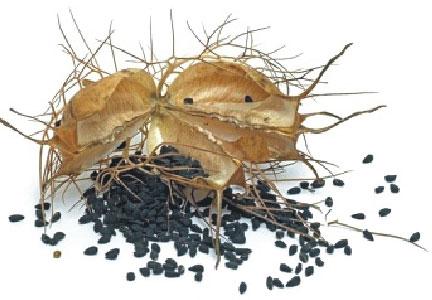
Nigella sativa is an annual flowering plant, native to south and southwest Asia. It grows to 20–30 cm (7.9–12 in) tall, with finely divided, linear (but not thread-like) leaves. The flowers are delicate, and usually coloured pale blue and white, with five to ten petals. The fruit is a large and inflated capsule composed of three to seven united follicles, each containing numerous seeds. The seed is used as a spice.
In English, Nigella sativa seed is variously called fennel flower, nutmeg flower, Roman coriander, blackseed or black caraway. Other names used, sometimes misleadingly, are onion seed and black sesame, both of which are similar-looking, but unrelated.
Characteristics
Nigella sativa has a pungent bitter taste and smell. It is used primarily in confectionery and liquors. Peshawari naan is, as a rule, topped with kalonji seeds.
History
According to Zohary and Hopf, archeological evidence about the earliest cultivation of N. sativa “is still scanty”, but they report supposed N. sativa seeds have been found in several sites from ancient Egypt, including Tutankhamun’s tomb. Although its exact role in Egyptian culture is unknown, it is known that items entombed with a pharaoh were carefully selected to assist him in the afterlife.
The earliest written reference to N. sativa is thought to be in the book of Isaiah in the Old Testament, where the reaping of nigella and wheat is contrasted. Easton’s Bible dictionary states the Hebrew word ketsah refers to N. sativa without doubt (although not all translations are in agreement). According to Zohary and Hopf, N. sativa was another traditional condiment of the Old World during classical times; and its black seeds were extensively used to flavor food. Original black cumin (Carum bulbocastanum) is rarely available, so N. sativa is widely used instead; (in India, Carum carvi is the substitute).



Connect with us





 For Buyer
  For Seller
  Help
Help 
 Sector 1, Mumbai, Maharashtra
  Send Enquiry