 3.85 Lakh / piece
Company Information
 Member Since 1 Year
 Nature of Business Manufacturer
 GST No. 29**********Z1
Ask for more detail from the seller
Contact Supplier
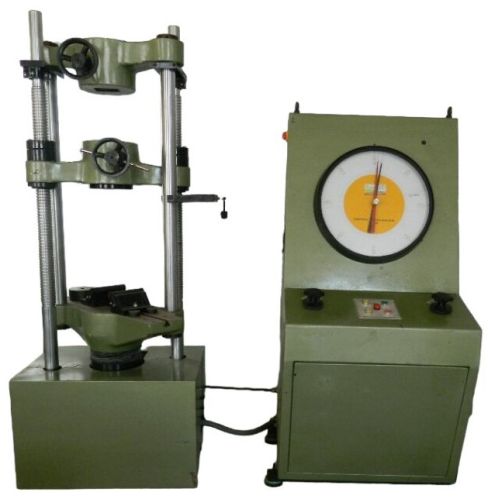
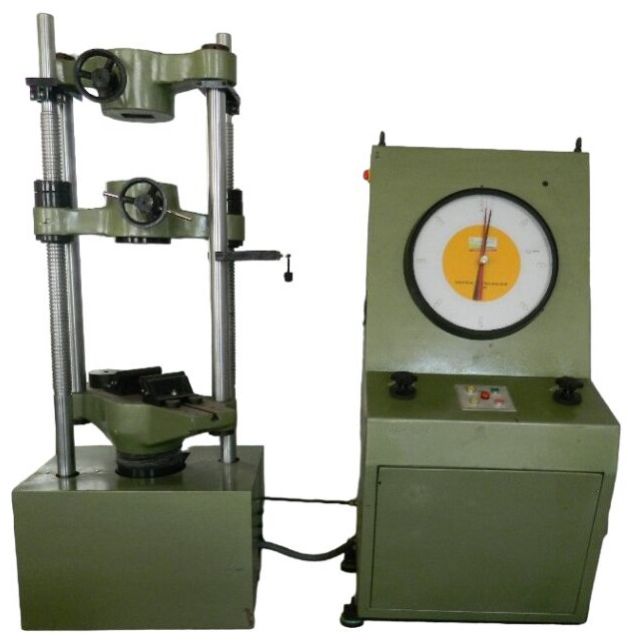
Universal Testing Machine
A Universal Testing Machine (UTM) is a versatile material testing system used to evaluate the mechanical properties of materials under tension, compression, bending, and shear. It's used widely in material science, civil, mechanical, and structural engineering.
Below are the typical specifications of a Universal Testing Machine (both general-purpose and standardized per common industrial/laboratory use):
✅ Universal Testing Machine – General Specifications1. CapacityLoad Range: Commonly available in capacities of
10 kN, 20 kN, 50 kN, 100 kN, 200 kN, 400 kN, up to 2000 kN
Select based on the application: metals, concrete, polymers, etc.
Type: Dual column (electromechanical or hydraulic)
Structure: Rigid, high-strength steel or cast iron
Crosshead Movement: Motorized or hydraulic with adjustable speed
Workspace: Varies with machine size (vertical clearance, width between columns)
Electromechanical UTM: Uses servo motor with screw drive
Hydraulic UTM: Uses hydraulic power pack and actuator for loading
Load Cell: High-accuracy, strain gauge-based
Accuracy Class: Typically ±1% or better, conforming to ISO 7500-1 / ASTM E4
Extensometer: Clip-on or non-contact type for accurate strain measurement
Resolution: As fine as 0.001 mm
Travel Range: Depends on sample and test type
Tensile Grips: Wedge, pneumatic, or hydraulic
Compression Platens: Hardened steel
Flexure Fixtures: For 3-point or 4-point bending
Custom fixtures for shear, peel, tear, etc.
Manual / Semi-automatic / Fully Computerized
Software: Windows-based interface for:
Test setup (tensile, compressive, flexural, etc.)
Real-time plotting (stress-strain curves)
Data analysis and report generation



Connect with us





 For Buyer
  For Seller
  Help
Help 

 Yelahanka, Bengaluru, Karnataka
 Send Enquiry