-
Min. Order (MOQ)
1 Piece(s)
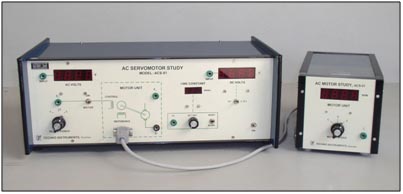
We offer A.C. Servomotor Study usefull for control laboratory experiments. Two phase a.c. servomotor is one of the very important electromechanical actuators having applications in the area of control systems. The study of its operating principle and features form a part of the first course on automatic control systems in electrical engineering curriculum. It's small size, low inertia and almost noise and frictionless operation makes the a.c. servomotor particularly attractive in aircraft and spacecraft applications.The characteristics of an a.c. motor is usually non-linear. To simplify the analysis a linearized model is developed. The experimental work revolves around determination of the parameters of the motor and thus its transfer function.Important subsystems of the unit includes, (a) an integrated speed sensor with 4-digit display in r.p.m.(b) an electrical loading system to compute torque(c) a time-constant measurement circuit with 3-digit display in milli seconds(d) a three step a.c. source with built-in r.m.s. voltmeter, and(e) a digital voltmeter on the panel for load measurementThe unit has been designed such that expensive equipment like storage CRO is not needed. Also the hassle of direct torque measurement using spring balance etc. is avoided by linearization of the motor characteristics analytically. Highlights of Equipment Torque computation through electrical loadingDetermination of motor para-meters - inertia and frictionDigital display of time constantTransfer function evaluation Experiments Inertia and friction parametersTime constantTransfer function Features and Specifications 2-phase a.c. servomotor - 12V/ 50Hz per phaseSmall generator for loading4-digit speed display3-digit time constant display3 digit r.m.s. voltmeter 3 digit d.c. panel meterVoltage regulated internal suppliesDetailed literature with sample results The experiment is complete in all respect.

 Write a Review
 Ravi Prakash (Ses Instruments Pvt. Ltd.)
 452 Adarsh Nagar, Roorkee, Uttarakhand - 247667, India
 Share us via









