Write a Review
Our Products
We are leaders in the market for providing best range of Turmeric, Tamarind Pods, Cinnamon, Star Anise and Curry Leafs

description
turmeric is the boiled, dried, cleaned and polished rhizomes of curcuma longa. The plant is a herbaceous perennial, 60-90 cm high, with a short stem and tufted leaf. There are 7 to 12 leaves, the leaf sheaths forms the pseudo stem. The lamina is green above and pale green below and has a length of 30-40 cm and width 8-12 cm. Inflorescence is a central spike of 10-15 cm length. 1-4 flowers are born in axil of the bract opening one at a time. About 30 flowers are produced in a spike. Seeds are produced in capsules and there will be one to numerous sunken capsules in an inflorescence.
origin and distribution
it is a native of india. Apart from india, it is cultivated in pakistan, malaysia, myanmar, vietnam, thailand, philippines, japan, korea, china, sri lanka, nepal, east & west africa, south pacific islands, malagasy, caribbean islands and central america. In india, it is cultivated in the states of andhra pradesh, maharashtra, orissa, tamil nadu, karnataka and kerala.turmeric is a tropical crop cultivated from sea level to 1200 meter msl. It grows in light black, black clayey loams and red soils in irrigated and rainfed conditions. The crop cannot stand water logging or alkalinity.
uses
turmeric is used to flavour and to colour foodstuffs. It is a principal ingredient in curry powder. Turmeric oleoresin is used in brine pickles and to some extent in mayonnaise and relish formulations, non-alcoholic beverages, gelatins, butter and cheese etc. The colour curcumin extracted from turmeric is used as a colourant.turmeric is also used as a dye in textile industry. It is used in the preparation of medicinal oils, ointments and poultice. It is stomachic, carminative, tonic, blood purifier and an antiseptic. It is used in cosmetics. The aqueous extracts has biopesticidal properties.
botanical name family name commercial partcurcuma longa l. Zingiberaceae rhizome or underground stem
indian names
name in international languages

Description
The ripe fruit of tamarind tree is used as a condiment. It is a moderate size to large, evergreen tree, up to 24 mtr in high and 7 mtr in girth. Bark is brown or dark gray, longitudinally and horizontally fissured. Leaves are paripinnate up to 15 cm long, leaflets are 10-20 pairs, oblong, 8-30 mm. Flowers are small, yellowish with pink stripes, pods are 7.5-20 cm long, 2.5 cm broad, 1 cm thick, more or less constricted between seeds, slightly curved, brownish coloured. Seeds are 3-12 oblong compressed, 1.5 cm, dark brown shining. Endocarp is light brownish, sweetish or acidic, edible pulp, traversed by branched ligneous strands. The outer cover of the pod is fragile and easily separable.
Origin and Distribution
Tamarind is originated in Madagascar and is now extensively cultivated in India, Myanmar, Bangladesh, Malaysia, Sri Lanka, Thailand, several African, Central American and South American countries. In India, it is chiefly grown in Madhya Pradesh, Andhra Pradesh, Tamil Nadu and Karnataka.The tree is not exacting as regards to soil but thrives best in deep alluvium. The tree prefers warm climate but sensitive to frost. Tamarind is suited to semi-tropical region with low rainfall. It can come up even in saline, alkaline and gravelly soils, and soils prone to erosion.
Uses
Tamarind pulp is used in numerous culinary preparations. It is also a raw material for the preparation of wine like beverages. The tamarind kernel powder is found to be extensively used for its sizing properties, in textile, confectionary, cosmetics and pharmaceutical industries. The testa is used in dyeing and tanning industry. The tender leaves and flowers are used as vegetables.In medicine, it is used as appetizing, laxative, healing and anti-helmintic. It is also used against fluorosis.
Botanical name Family name Commercial partTamarindus indica L. Cesalpiniaceae Pods
Indian Names
Name in international languages

Description
The True Cinnamon or Sri Lankan Cinnamon is the dried inner stem bark of Cinnamomum Verum. Cinnamon plants are grown as bushes. When the plants are of two years age, they typically measure at about 2 meter in high and 8-12 cm at the base. It is at this stage they are ready for harvesting.
Origin and Distribution
Cinnamomum verum is mostly cultivated in Sri Lanka, Malagasy Republic and Seychelles. It has originated in the central hills of Sri Lanka. In India, it is grown in one or two locations in Kerala. Cinnamon is a hardy plant and is cultivated in Sri Lanka under varying conditions ranging from semi dried to wet zone conditions. The ideal temperature for growing cinnamon is between 20-30 degree C and rainfall between 1250 to 2500 mm. It thrives well as a forest tree at 300-350 meter above MsL.
Uses
The commercial products of cinnamon are quills, quillings, featherings, chips, cinnamon bark oil and cinnamon leaf oil. Quills are scraped peel of the inner bark of the mature cinnamon shoots, joined together with overlapping tubes, the hollow of which has been filled with smaller pieces of cinnamon peels which is dried first in the sun and thereafter in the shade. Quillings are broken pieces and splits of all grades of cinnamon quills. Featherings are feather like pieces of inner bark consisting of shavings and small pieces of bark left over. Cinnamon chips are rough unpeelable barks scraped off from the thicker stems. Cinnamon leaf and bark oil are obtained by distilling the leaf and bark separately. Cinnamon bark is a popular spice with a delicate fragrance and a warm agreeable taste. It is used in the form of small pieces or powder. It is widely used in flavouring confectionary, liquors, pharmaceuticals and cosmetics. It is found to help diabetics in digestion of sugar. It has astringent; stimulant and carminative properties and can check nausea and vomiting. The cinnamon bark oil has anti-fungal properties and cinnamon leaf oil is widely used in perfumery and cosmeticsBotanical name Family name Commercial part Cinnamomum verum Lauraceae Bark, leaf
Indian Names
Name in international languages
Description
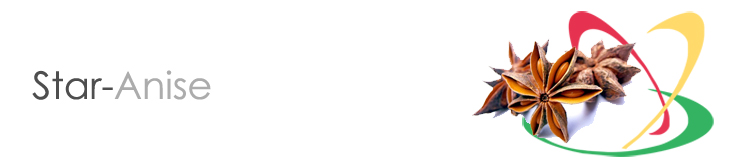
Star anise is the dried, star shaped fruit of Illicium verum. It is an evergreen tree attaining a height of 8-15 meters and a diameter of 25 cm. The leaves are entire, 10-15 cm long, 2.5 5 cm broad, elliptic, flowers are solitary, white to red in colour. Fruits are star shaped, reddish brown consisting of 6-8 carpels arranged in a whorl. Each carpel is 10 mm long, boat shaped, hard and wrinkled containing a seed. Seeds are brown, compressed, ovoid, smooth, shiny and brittle.
Origin and Distribution
Star Anise is indigenous to South Eastern China. Commercial production is limited to China and Vietnam. In India, it is produced to a small extent in Arunachal Pradesh.The crop requires specific agro climatic conditions available only in the traditional growing areas, which has prevented repeated attempts of other countries to grow star anise. However it prefers woodlands, sunny edges, and dappled shade. The plant grows well in humus rich, mildly acidic to neutral soils, which are light to medium and having good drainage. It tolerates temperatures down to 10 degree C.
Uses
Star anise is one of the signature flavours of Chinese savory cooking. The five-spice powder mix common in China contains star anise. It is used to flavour vegetables, meat, and to marinate meat. It is used as a condiment for flavouring curries, confectionaries, spirits, and for pickling. It is also used in perfumery. The essential oil of star anise is used to flavour soft drinks, bakery products and liquors.The fruit is anti-bacterial, carminative, diuretic and stomachic. It is considered useful in flatulence and spasmodic.
Botanical name Family name Commercial partIllicium verum Illiciaceae Dried Fruit
Indian Names
Name in international languages

Description
The leaves of curry leaf tree is a spice. The tree is an aromatic deciduous one, five meter in height, 15-40 cm in diameter. It is cultivated mainly in homesteads but to a certain extent on a plantation scale.
Origin and Distribution
Curry leaf is found almost throughout India up to an altitude of 1500 mtrs. It is much cultivated for its aromatic leaves.
Uses
The leaf is used in South India as a natural flavouring agent in various curries. Volatile oil is used as a fixative for soap perfume. The leaves, bark and root of the plant are used in the indigenous medicine as a tonic, stimulant, carminative and stomachic.
Botanical name Family name Commercial partMurraya koenigii (L.) Sprengel Rutaceae Leaf
Indian Names
Name in international languages
Description
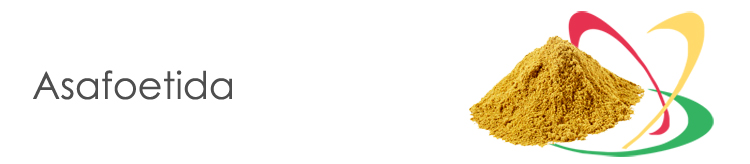
Asafoetida is the dried latex (gum oleoresin) exuded from the living undergroundrhizome or tap root of several species of Ferula (three of which grow in India), which is a perennial herb (1 to 1.5 mtr. High).
Origin & Distribution
The species are distributed from the Mediterranean region to Central Asia. In India it is grown in Kashmir and in some parts of Punjab. The major supply of asafoetida to India is from Afghanistan and Iran.There are two main varieties of asafoetida ie. Hing Kabuli Sufaid (Milky white asafoetida) and Hing Lal (Red asafoetida). Asafoetida is acrid and bitter in taste and emits a strong disagreeable pungent odour due to the presence of sulphur compounds therein.The white or pale variety is water soluble, whereas the dark or black variety is oil soluble.Since pure asafoetida is not preferred due to its strong flavour, it is mixed with starch and gum and sold as compounded asafoetida mostly in bricket form. It is also available in free flowing (Powder form) or in tablet forms.
Uses
Asafoetida is extensively used for flavouring curries, sauces, and pickles. It is also used in medicines because of its antibiotic properties.Botanical name Family name Commercial partFerula asafoetida Apiaceae Oleogum resin extracted from rhizome and thickened root
ndian Names
Name in international languages
 Vidhata Impex (Vidhata Impex)
 D-7/8 Indraprastha (chs)
J.N Road,
Sarvodaya Nagar,
Mulund(w),
:-, Mumbai, Maharashtra - 400080
D-7/8 Indraprastha (chs)
J.N Road,
Sarvodaya Nagar,
Mulund(w),
:-, Mumbai, Maharashtra - 400080 Share us via