| While elsewhere asphalt is the term used for a mixture of small stones, sand, filler and bitumen, which is used as a road paving material. The asphalt mixture contains approximately five per cent bitumen.At ambient temperatures bitumen is a stable, semi-solid substance. Uses
The vast majority of refined bitumen is used in construction. Not in itself an end-product, bitumens primary use is as a constituent of products used in paving and roofing applications.
Approximately 85 per cent of all the bitumen produced worldwide is used as the binder in asphalt for roads. It is also used in other paved areas such as airport runways, car parks and footways. Typically, the production of asphalt involves mixing sand, gravel and crushed rock with bitumen which acts as the binding agent. Other materials, such as polymers, may be added to the bitumen to alter its properties according to the application for which the asphalt is ultimately intended.
A further 10 per cent of global bitumen production is used in roofing applications, where its waterproofing qualities are invaluable.
The remaining five per cent of bitumen is used mainly for sealing and insulating purposes in a variety of building materials, such as pipe coatings, carpet tile backing and paint.
Common misunderstandings
Bitumen is often confused with tar. Although bitumen and coal tar are similarly black and sticky, they are distinctly different substances in origin, chemical composition and in their properties. Coal tar is produced by heating coal to extremely high temperatures and is a by-product of gas and coke production. It was widely used as the binding agent in road asphalt in the early part of the last century, but has since been replaced by refined bitumen.
Bitumen is also sometimes confused with petroleum pitch which, although also derived from crude oil, is a substance produced by a different process from that used for refined bitumen. Petroleum pitches are the residues from the extreme heat treatment or cracking of petroleum fractions. Their properties and chemical composition are therefore quite different from those of bitumen.
Naturally-occurring bitumen, sometimes also called natural asphalt, rock asphalt, lake asphalt or oil sand, has been used as an adhesive, sealant and waterproofing agent for over 8, 000 years. But it occurs only in small quantities and its properties are quite different from refined bitumen.
Industry Facts
Bitumen production
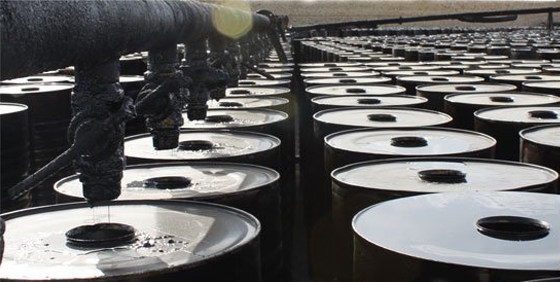
Refined bitumen is derived from crude petroleum. The European bitumen industry (EU 15) produces some 16 million tonnes each year for use in the manufacture of road materials and a wide variety of specialist building and industrial products. 85 - 90 per cent is used in the construction and maintenance of bituminous, or asphalt roads.
The production is a specialist activity and is not carried out in all oil refineries. Bitumen requires crude oils with specific characteristics and only some crude oils are suitable. There are 94 oil refineries in Europe (EU15) of which 63 produce bitumen.
Bitumen is an engineering material and is produced to meet a variety of end-use specifications based upon physical properties. Bitumen may be customised for special road applications and hundreds of grades have also been developed for the non-road industrial segment, including roofing and sound-proofing.
Asphalt
Asphalt is typically a mix of approximately 95 percent aggregate and sand, and 5 percent of bitumen, which acts as the binder. There are over 4, 000 hot mix asphalt plants in Europe, producing some 300 million tonnes of hot mix asphalt per year.
Asphalt is fully recyclable and recycling has increased significantly in recent years. Quantities recycled directly back into road surfaces vary from country to country, but can be as high as 70%.
Bituminous Pavements
Built to last
Modern asphalts roads, with a solid base course and protective replaceable wearing course, are now designed to last for over 40 years and with correct surface maintenance they can last even longer.
Noise reduction
Use of asphalt road surfaces can significantly reduce noise both inside and outside the car, preventing accidents by alleviating a source of stress that contributes to driver fatigue. After speed and alcohol abuse, driver fatigue is the next most frequent cause of accidents.
Standard asphalt roads have the lowest noise levels of the traditional road surfaces and the recent development of porous and silent asphalts have reduced noise levels even further. A standard asphalt surface produces half the noise generated by a standard concrete surface and porous asphalt reduces this by a further 50 per cent.
Surface water dispersal
New asphalt technology ensures rapid dispersal and drainage of surface water, reducing water spray and therefore improving visibility for the driver in wet conditions. The new porous asphalt materials dramatically reduce blinding spray and by dispersing surface water they also reduce the risk of aquaplaning and increase the visibility of road markings.
Skid resistance
Drainage and texture of the road surface are the two crucial elements that aid skid resistance. Much research has been dedicated to the removal of water and provision of vehicle tyre grip. The drainage capability of porous asphalts and precision in aggregate mix play a vital role in skid resistance.
Todays asphalt surfaces have been developed to provide a skid resistant texture, without the need for protruding aggregates that contribute to traffic noise. They therefore also give the driver a smoother ride.
Asphalt surfaces that provide higher levels of skid resistance can be used where safety is paramount, for example, outside schools or where there are extreme road gradients or bends.
Easy maintenance - less traffic disruption
Asphalt roads can be easily opened and quickly reinstated to install or repair utilities. This speed in accessing water mains, gas pipes, or telephone cables is crucial in minimising the associated congestion and driver frustration.
Clearer lane marking with coloured asphalts
Another recent asphalt advance has been the development of coloured surfaces. These are increasingly used as a safety mechanism to make it easier for drivers to identify lanes set aside for special uses, such as bus lanes, bus stops and cycle paths. Coloured asphalt is also used to alert driver attention to dangerous areas such as hidden junctions or sharp bends.
Totally recyclable
Asphalt is 100 per cent recyclable and is routinely milled and re-laid along with fresh materials, saving money and preserving non-renewable natural resources.
Recycling also reduces the use of virgin quality gravel, preserves landfill and saves transport.
Versatile and flexible
Asphalt surfaces can be tailor-made appropriately formulated and designed to support the traffic load and climatic conditions of a specific road. There are asphalt solutions for motorways, urban, suburban and rural roads and its flexibility is particularly useful in coping with the stresses of large traffic loads on bridges.
In areas where roads have to cope with frequent freezing and thawing, thanks to the elasticity of bitumen, asphalt surfaces can be designed to tolerate extreme temperature cycles. Where studded tyres are used in cold climates, the maintenance advantages of asphalt are also critical.
After construction the flexibility of asphalt allows for easy surface improvement and road widening, as new requirements arise. |
 Write a Review
 Zubin (Ctc Inc)
 Bhagwan Niwas 161 , Ashoka Enclave 1, Sec -34, Faridabad-121003, Haryana,, Sector 34 - 110006, India
 Share us via








