 Write a Review
Our Products
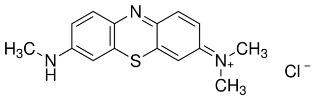
Leading Manufacturer, Supplier & Retailer of Bromothymol Blue ACS Grade, Giemsa Stain, Aurin P Rosolic Acid, Bromoxylenol Blue and AZURE B.
Chemical Name
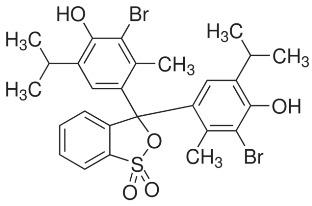
4, 4-(1, 1-Dioxido-3H-2, 1-benzoxathiole-3, 3-diyl)bis(2-bromo-6-isopropyl-3-methylphenol).
InChI Key
NUHCTOLBWMJMLX-UHFFFAOYSA-N
Solubility
Soluble in alcohol and aqueous solutions of alkali; sparingly soluble in water. Soluble in ethanol, ether and alkalis. Slightly soluble in water.
Bromothymol blue is a large compound with a molecular weight of 625 g/mol. It contains three aromatic benzene rings. The first benzene ring has a thym group attached (the 'thym' part of the name), a sulfur with two oxygen atoms double bonded to it, and another oxygen single bonded to it. The second and third benzene rings each have a bromine (the 'bromo' part of the name), alcohol (the 'ol' suffix), a tert-butyl group, and a methyl group. This 0.1% aqueous bromothymol blue solution (also known as Bromthymol Blue) is a commonly used pH indicator. Bromthymol blue changes color over a pH range from 6.0 (yellow) to 7.6 (blue). It is a good indicator of dissolved carbon dioxide (CO2) and other weakly acidic solutions. Despite its name, bromothymol blue solution may sometimes appear yellow or reddish depending on the pH of the stock water used to prepare this pH indicator solution. Low levels of carbon dioxide or acid in solution with bromothymol blue indicator will appear blue. As the level of carbon dioxide or acid increases, the solution will gradually take on a yellow tint. This makes bromothymol blue ideal for biology experiments to indicate photosynthetic activity (solution turns blue as plants use up carbon dioxide) or respiratory activity (solution turns yellow as carbon dioxide content increases).
Applications:
Bromothymol blue solution is used as an indicator to determine the rough pH of a substance. It is prepared from a powder, household items and common laboratory chemicals that can be obtained through a scientific supply house individually or as a kit. The mixed bromothymol blue solution will turn yellow in an acidic solution and blue in basic solutions.The main uses of bromothymol blue are for testing pH and for testing photosynthesis and respiration. Bromothymol blue has a blue color when in basic conditions (pH over 7), a green color in neutral conditions (pH of 7), and a yellow color in acidic conditions (pH under 7). So, if we are watching a reaction as it changes pH, we can watch the color change and determine when the pH changes. This is helpful for determining the buffer strength of solutions or determining the end point of pH-dependent reactions. Bromothymol blue is effective when used at a pH range of 6.0-7.6. Below 6.0, it will still be yellow, but it won't deepen in yellow any further, and above 7.6, it will still be blue, but it just won't deepen in blue any further. Bromothymol blue can also be used for testing photosynthesis and respiration, using the same technique as used for pH testing. As photosynthesis occurs, carbon dioxide is used up, and as respiration occurs, carbon dioxide is produced. The changing level of carbon dioxide also changes the pH of the solution because carbon dioxide reacts with water to form carbonic acid, and carbonic acid decreases the pH of the solution.
Solubility
Insoluble in water (<0.1%), methanol (5.8 mg/l), and ethanol.
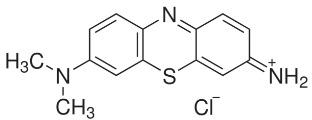
Giemsa Stain is a laboratory reagent and stain for microscopy. A compound of eosin with methylene blue and its oxidation products. When blood films are stained using Giemsa stain, the nucleus and cytoplasm of white blood cells take on a characteristic blue or pink coloration. Giemsa stain functions by rearranging chromatin and inducing G bands producing a high quality stain for chromatin and the nuclear membrane. Giemsa stain is used to differentiate nuclear and/or cytoplasmic morphology of platelets, RBCs, WBCs, and parasites (1, 2). The most dependable stain for blood parasites, particularly in thick films, is Giemsa stain containing azure B. Liquid stock is available commercially. The stain must be diluted for use with water buffered to pH 6.8 or 7.0 to 7.2, depending on the specific technique used.
Applications:
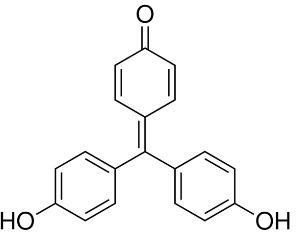
Giemsa and May Grünwald solutions are intended for use in staining blood films or bone marrow films. Solutions are for “In Vitro Diagnostic Use.” Giemsa stain is a buffered thiazine-eosinate solution designed to provide coloration of blood cells similar to the original product described by Giemsa. It may be used separately or in combination with a May Grünwald Stain, also available from Sigma-Aldrich. Giemsa stain is a biological stain for thin blood films to differentiate leucocytes, for thick blood films to show malarial parasites, and for bone marrow to show cell morphology. It is also used as a chromosome stain and to differentiate nuclear morphology of platelets, RBCs, and other cell types. Giemsa Stain was designed primarily for the demonstration of parasites in malaria, but it was also employed in histology because of the high-quality staining of the chromatin and the nuclear membrane, the metachromasia of some cellular components, and the different qualities of cytoplasmic staining depending on the cell type. The use of methylene azure and its mixture with methylene blue to form an eosinate made stable the stain and its results. Giemsa's stain is regarded as the world's standard diagnostic technique for malaria's plasmodium, and it is also the basic stain for classifying lymphomas in the Kiel classification.
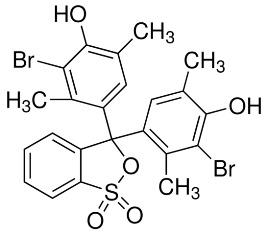
Chemical Name
3, 3-bis(3-bromo-4-hydroxy-2, 5-dimethylphenyl)-2, 1$l^6-benzoxathiole-1, 1-dione
InChI Key
MRDOFVRMTNWMDA-UHFFFAOYSA-N
Solubility
Soluble in alcohol and aqueous solutions of alkali; sparingly soluble in water. Soluble in ethanol, ether and alkalis. Slightly soluble in water.
Xylenol blue, shown the double working ranges of utility with those of thymol blue. The pair of indicators thus share with certain other pairs of homologous indicators the property of anomalous unshifted PH ranges. Advantage was taken of this property in the case of xylenol blue to obtain a solution of twice the intensity of thymol blue. When the PH range of The bromo-derivative of xylenol blue was investi-gated in the same manner as that of the unbrominated indicator, and compared with bromothymol blue in identical concentrations and strengths of indicator in buffer solutions of PH6*0-7*6, the series in each case was similar. The analogy of xylenol blue with thymol blue in-respect of range of PH is thus continued on bromination.
Applications:
Near Neutral pH Indicating properties of Bromoxylenol Blue are used in optical lenses, diagnosis of multiple diseases, sol-gel matrix, determination of drugs, lubricants, toys, paints, microorganism detection, cosmetics and food storage and shelf life indication.The relationship between the activity of hydrogen ions [exactly hydronium ions, H(H2O)n+] and concentration of a solution is fundamentally important to determine the extent of a chemical reaction, as it affects the equilibria and kinetics of a wide variety of chemical and biochemical reactions. The hydrogen-ion activity refers to the effective concentration of unassociated hydrogen ions, the form that directly affects physicochemical reaction rates and equilibria. The symbol, pH, numerically relates the hydrogen ions concentration or activity. The pH is approximately equal to the negative logarithm of H+ concentration expressed in molarity. pH 7 is neutral; above it alkalinity increases and below it acidity increases. pH indicators are usually weak acidic or basic organic tautomers which exist in more than one structural form of which at least one form is characteristically colored in relation to different electronic configuration of the bound. Indicators should not change color exactly at one pH value, but within a wide pH range. The transition point of an indicator is defined as the point at which the acid and alkaline forms of the indicator exist in equal concentrations.
 . (GSP Chemical Industries)
 ESJAY CHEMICALS N - 208 / 209, MIDC, Tarapur, Palghar, Maharashtra - 401506, India
 Share us via