
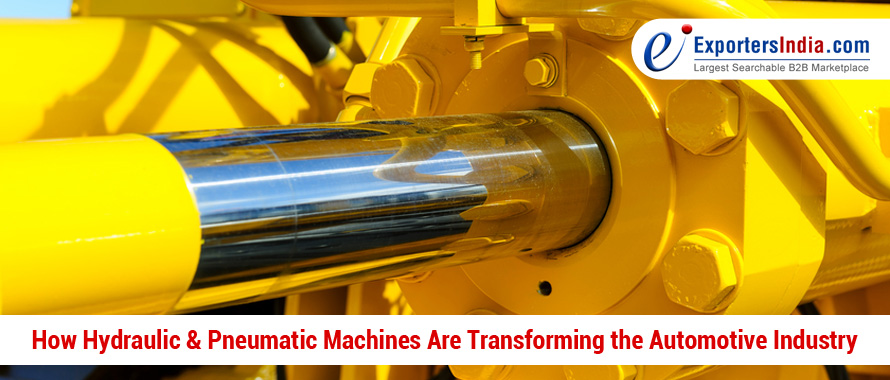
The automobile market requires precision and quality. These are activated by hydro and pneumatic machines. They utilize fluid or air pressure to carry out tools. These systems are in line with car parts. They are quick in manufacture and are not faulty. They are useful, be it the bending of metal or the assembly of the parts. In this blog, we get to see a blog on the different kinds of hydraulic and pneumatic machines. It talks about their roles and benefits in the production of automobiles. Through this blog, let's see how these machines enhance automotive innovation. Their power and accuracy revolutionize the industry.
Hydraulic and pneumatic systems make use of fluid or air to generate force. They drive heavy and specific jobs. They automate automobile factories. These technologies are quality and speedy. They deal with shaping up to assembly. Modern car manufacturing is backed up by its reliability.
Hydraulic machines are heavy-duty machines that employ the use of liquid pressure. They manipulate and cut automotive production materials. The major ones are Hydraulic Equipment, Hydraulic Bending Machine, Hydraulic Cutting Machine, Hydraulic Shearing Machine and Hand Operated Hydraulic Press. These are machines used in such work as chassis shaping or panel shaping. They guarantee constant and quality production of cars.
Parts are molded using hydraulic presses. They are crucial in the production of long-life automotive parts. There are subcategories such as Hand Operated Hydraulic Press, Hydraulic Forming Press, Industrial Hydraulic Press, Heavy Duty Hydraulic Press, Closed Frame Hydraulic Press and Dishing Press. These presses are used in activities such as molding hoods or engine blocks.
Hydraulic components keep the system in operation. They regulate the circulation of fluid and the breakdown. They can be Hydraulic Spares, Hydraulic Cap, Oil Hydraulic Trainer, Hydraulic Pullers, Hydraulic Manifold Block and Piston Seals. These components make sure machines are running efficiently in the process of automobile production.
Compressed air is used by pneumatic machines. Their weight is low and the assembly is speedy. They are of the type Pneumatic Parts, Pneumatic Presses, Pneumatic Equipment, Pneumatic Accessories and Pneumatic Fixtures. These gadgets perform tedious duties such as nailing or arranging. They increase productivity within car plants.
Recycling or molding of materials is done by hydraulic baling presses. They encourage optimality and sustainability. They are of different types such as Baling Press, Rubber Moulding Press, Scrap Baling Press, Baling Machine, and Compression Presses. These are machines used to compress scrap or mould rubber into tires.
Some machines are exceptional in automobile production. Five major systems and their functions are indicated in the table below:
| Machine | Role in the Automotive Industry |
| Hydraulic Deep Drawing Press | Shapes metal into complex forms like car panels or fuel tanks. |
| Pneumatic Actuator | Drives precise movements in assembly lines for clamping or lifting. |
| Air Pressure Regulator | Maintains consistent air pressure for reliable pneumatic tool performance. |
| Hydraulic Shearing Machine | Cuts metal sheets precisely for parts like doors or frames. |
| Hydraulic Bending Machine | Bends metal into specific angles for chassis or bumper components. |
Those machines facilitate production. Deep drawing presses are used to produce parts that are seamless. Some actuators are used to provide smooth assembly. Stabilizers on the pneumatic systems are provided by regulators. Materials are precise in shearing and bending machines. They minimize mistakes and increase production.
These machines are revolutionary in automobile manufacturing. They offer essential efficiency, quality and longevity benefits.
The manufacturing of cars depends on hydraulic and pneumatic machines. They drive the shaping, assembling and recycling. They are very accurate, hence quality vehicles. Components and hydraulic presses are durable. Speed and accuracy: Pneumatic tools are fast and precise. Baling presses encourage sustainability. The combination helps to minimize the expenses and increase safety. They facilitate new designs of vehicles. With the development of automation and AI, their place will increase. The engines of automobile manufacturing are these machines. They push productivity and development. They determine the future of car manufacturing.





Connect with us





