 GST : 05AACPY6891P2ZO
 5.0/5
5.0/5
Our Products
Our Complete range of products are Thevetia Neriifolia Seeds, Bambusa Arundinacea Seeds, Acacia Catechu Seeds, Acacia Nilotica Seeds and Artocarpus Heterophyllus Seeds.
Thevetia neriifolia a large, evergreen shrub, 4.5 - 6.0m tall, native of tropical America and the West Indies, but naturalized and cultivated in gardens in the plains throughout India. Leaves 10-15cm long, linear, acute; flowers bright yellow or pinkish yellow, in terminal cymes, scented; drupes triangular, fleshy, with 2-4 seeds. Fruit is small, containing two to four flat seeds. If ingested may experience pain in the mouth and lips, may also develop vomiting, cramping, abdominal pain, nausea and bradycardia shortly after ingestion. Mexican oleander is native to tropical America.
Bambusa arundinacea a graceful, spinous bamboo, distributed throughout the moist parts of India, up to an altitude of 1, 250m, particularly near river banks; native to south-east Asia, also cultivated in the plains of North-West India, and on the hills of Andhra Pradesh, Tamil Nadu and Karnataka. It flowers gregariously once in 30-40 years. Rhizomes short, stout, knotty; culms dense, reaching 24-30m in height and 15-17cm in diam, green, hollow, purplish green when young, turning golden yellow, with prominent nodes and long internodes, lower ones rooting, often sub-angular, flexuous; leaves linear or linear-lanceolate, 7-18cm x 2-20mm; flowers in large panicles, sometimes occupying the whole culm; caryopsis oblong 5-8mm long, grooved on one side. The sprouts are acrid, bitter, laxative and are useful in inflammations, ulcers and wounds. Extract is used to treat various inflammatory conditions.
Acacia catechu, also known as Cutch tree, is a deciduous, moderate-sized tree, growing up to a height of 15 m rarely with a light feathery crown. The tree is found across India in dry mixed forests, generally as a small tree, up to a height of 3 m. The bark is dark, grayish brown, exfoliating in long, narrow strips, and the leaves are pinnate, with a pair of inwardly-curved prickles at the base of the rachis. Acacia catechu flowers measure about 2.5 - 3mm in length, are pale-yellow or white in color, and are in 5-10cm long, cylindrical spikes. The brown colored pods are glabrous, oblong and flattened, measure about 50-125mm in length, and contain 4-7 seeds. Acacia catechu seeds are flat, dark brown and measure 5-8 mm in diameter. The seeds are edible and the extract of its heartwood is an important ingredient of the traditional Indian 'Paan'. The extract is also useful in the treatment of many medical conditions in the Ayurveda.
Acacia nilotica, commonly known as Babul in the Indian subcontinent, is a medium sized tree, growing to about 7-13 m in height, with bark approximately 20-30 cm thick. The crown is more or less spherical, but can be flattened, as per the climatic conditions. The thorns are generally straight, while the leaves are bipinnate. Acacia nilotica flowers are golden yellow, scented and spherical in shape. Pods are slightly curved and strongly constricted to resemble beaded necklaces. On maturation, pods break transversely into different segments containing one Acacia nilotica seed per segment. The tree has numerous medicinal uses in the treatment of many medical conditions such as tuberculosis, gonorrhea, impotence, dysentery, diarrhea, toothache and hemorrhages. Acacia nilotica is very drought resistant, and can be grown on almost all types of soils. Acacia nilotica seeds require little scarification or boiling in water for successful germination, and the seeds must be sown separate from each other as they quickly develop the taproot.
Caesalpinia pulcherrima is a large shrub, generally grown in gardens for its showy reddish-yellow flowers. The plant attain a height of 3mt. Retains its leaves throughout the year. It mainly grows in frost free climates. The stem, branch and petiole are armed with sharp spines and the leaves are fern like twice compound with many small oval leaflets and leaves are fern like. The leaves and bark are emmenagogue, purgative and tonic. The bark is used as an abortifacient. An infusion of the flowers is said to be febrifuge (Kirt. & Basu, II, 848; Burkill, I, 390). The flowers contain: gallic acid, resins, benzoic acid, tannins, and a red colouring matter. The fruits are rich in tannins. A red dye has been isolated from the flowers. It is easy to grow from seed.
General Description:
Abrus precatorius is a winding climber with glabrescent, mostly greenish yellow young branches. The plant, a native of Indonesia also of tropical Africa and Madagascar is found throughout India, ascending to an altitude of about 1, 050m in the outer Himalayas. The plant is invasive in tropical climates, with deep roots, which can't be easily removed. Abrus precatorius seeds are poisonous. Alternate, peri pinnate leaves, alternately arranged. Every pod contains 3-5 seeds, oval in shape, which are about 6mm long. One seed is enough to kill an adult human being. The seeds are brightly colored, mostly a combination of black and red. Abrus precatorius seeds are widely used in jewelry and other artwork. The seeds have been traditionally used by Indians for weighing gold, due to their consistency in weight.

Crotalaria juncea an erect, shrubby annual, 1-4mt. high, with simple, narrow, sub-sessil leaves and fairly large, bright yellow flowers. The pods are tough skinned, and each of them contains a large number of small seeds. Sunn or sann hemp, also known as Indian or Bombay Hemp, is one of the most commonly cultivated fibre crops in India, ranking next in importance to jute as a bast fibre crop. It is cultivated nearly all over India, either for the fibre obtained by retting its stems or as a green manure crop in rotation with grain or cash crops. It is also used as green manure, and cover crop. It grows in moist well drained soil. It is drought tolerant.
Mangifera indica a large evergreen tree, 10.0 - 45.0 m. high, with a heay, dome-shaped crown and a straight, stout bole; bark thick, rough, dark grey, flaking off when old; leabves linear-oblong or elliptic-lanceolate, 10-30 cm. long and 2-9 cm wide, emitting when crushed an aromatic, resinous odour; inflorescence a large panicle, containing in some types more than 3000 flowers. flowers tiny, reddish white or yellowish green, pungently odorous and melliferous; staminate and hermaphrodite flowers borne in the same panicle; fruit a large drupe exceedingly variable in form and size; fruit skin thick or thin, leathery, green, yellowish or red, often dotted with numerous glands; flesh (mesocarp) whitish yellow, yellow or orange, firm, soft or juicy, sub-acid or sweet, richly aromatic; fibres throughout the flesh in some types, absent or very little in others; seed solitary, ovoidoblique, encased in a hard compressed fibrous endocarp (stone).
Nigella sativa a small herb, 12-18 in. high, native of Levant, said to be cultivated or occasionally found as a weed of cultivation in Punjab, Himachal Pradesh, Bihar and Assam. Leaves 2-3 pinnatisect, 2.5 - 5.0 cm long, cut into linear - lanceolate segments; flowers pale blue, 20 - 2.5cm across, without an involucre, on solitary long peduncles; seeds trigonous, black, rugulose tubercular.
Tecoma stans is An erect shrub or small tree, planted in gardens in the plains throughout India and in the hills, up to an altitude of 1, 500m. The plant attains a height of 1.5-5mt., occasionally 10mt . It is naturalized in most parts of India, and is also found as an escape in the waste, dry places near gardens and houses. Leaves odd-pinnate; leaflets 5-11, almost sessile, oblong-ovate, lanceolate, serrate; flowers yellow, fragrant, in terminal panicle, found throughtout the year; capsules linear, 12-20cm x 7cm., compressed; seeds numerous, each with 2, thin wings.
Gmelina arborea an anarmed tree, c. 20-30ft. high, with a clear bole of 20-30ft. and a girth of 5-7 ft., found scattered in deciduous forests throughout the greater part of India and the Andamans, up to an altitude of 5, 000 ft.; it is also planted in gardens and avenues. Bark smooth whitish grey; leaves opposite, broadly ovate, cordate, glandular; flowers in terminal panicles, brownish yellow; drupe fleshy, ovoid, 1 or 2 seeded.
Synonyms : Acacia leucophloea Willd., Acacia melanochaetes Zoll. Delaportea microphylla Gagnep. Delaportea ferox Gagnep. Mimosa leucophloea Roxb.
Albizia saman Middle sized to large evergeen tree with a short bole and an enormous, attins a height of 27mt., wide spreading umbrella-shaped crown extending to 30m in diameter. The leaflets fold with the sunset and unfold at the sunrise. Pods sessile, straight, black-brown, 12 - 25cm x 1.8 - 2.5cm, thick, flattened, with thick firm sutures, indehiscent, leathery, ripening black, seplate between the seeds. Seeds upto 25, 15mm long, brown, set in brownish pulp. The bark is dark grey, often bearing horizontal weals and the trunk frequently branches quite low down.
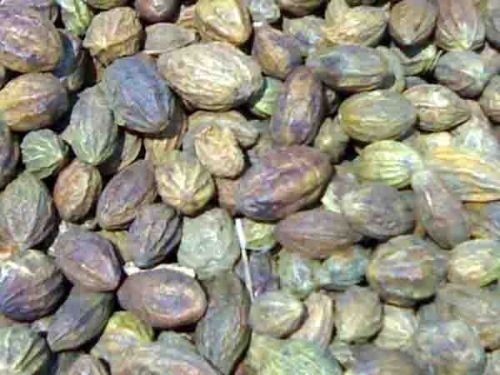
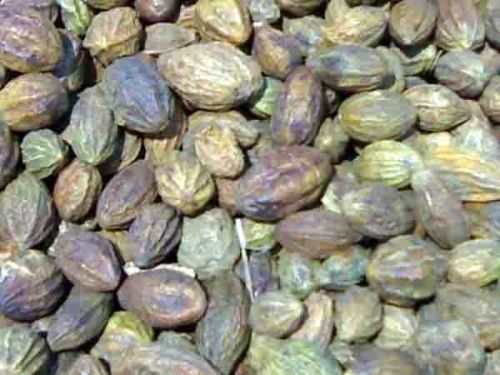
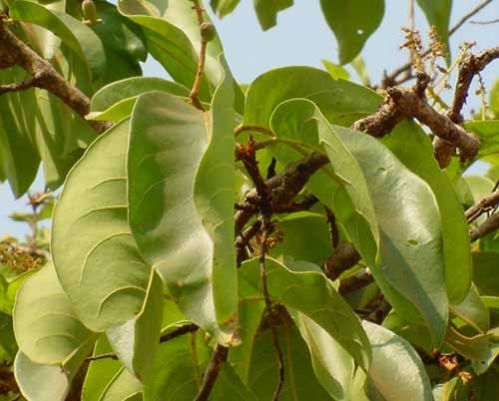
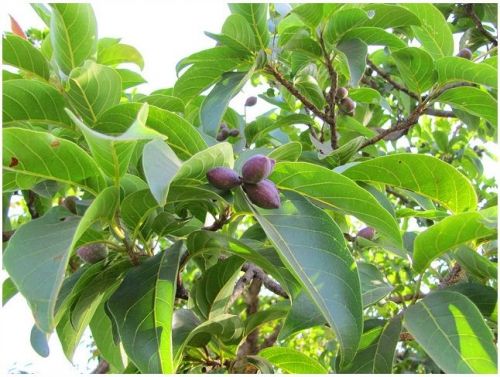
Terminalia chebula a tree 20mt. in height and 1.5-2.4m in girth, with a cylindrical bole of 4-9m a rounded crown and spreading branches, found throughout the greater parts of India. Bark dark-brown, often longitudinally cracked, exfoliating in woody scales; leaves ovate or elliptic with a pair of large glands at the top of the petiole; flowers yellowish white, in terminal spikes; drupes ellipsoidal, obovoid or ovoid, yellow to orange-brown, sometimes tinged with red or black and hard when ripe, 3-5cm long, become 5-ribbed on drving; seeds hard, pale yellow.T. chebula is found in the sub-himalaysn tracts from the Ravi eastwards to West Bengal and Assam, ascending up to an altitude of 1500m in Himalayas.
In the deciduous forests of India, it attains a girth of 1.5-1.8m., with a bole of 4.5-6.0m in length. In the moister forests of the west coast, it reaches a girth of 2.4m or more, with a bole of 9m. in favourable localities. In high-level rocky and dry places in the outer Himalayas and the hills of Deccan and South Indian it is a small tree. In its natural habitat, the absolute maximum shadetemperature varies from 36 to 17.5° and the absolute minimum from 0 to 15.5°, and the normal rainfall from 75 to 330cm. It is found on a variety of geological formations, growing on clayey as well as on sandy soils.

Thespesia populnea, a compact quick-growing, evergreen tree, 20-30 ft. in height and 1.2m in girth, with 2.5m clear bole, commonly found on the coasts of India and the Andamans; also grown elsewhere in gardens for ornament. Bark grey to brown, fissured, often knobby, fibrous, c. 4.0mm. thick; leaves cordate-ovate, dark green, 7-15cm. long; flowers yellow with purple base, completely changing to purple when about to wither, 5.0-7.5cm; capsules brown, globose or oblong, 2.5cm x 4.0cm, with persistent calyx; seeds pilose or powdery on the surface, flat, egg-shaped.The tree is largely cultivated for ornament and shade, and it blooms throughout the year in the tropics. It can grow everwhere including saline soils, except in hilly areas, but prefers light and porous soils. It thrives in moist and warm situations, but can withstand temperatures as low as - 4.

Jujuba Ziziphus a deciduous tree, up to 12m in height, sometimes a large bush, found both cultivated and naturalized in Punjab. Leaves ovate to oblong-oval or nearly lanceolate, 2.5-5cm long, obtusely serrate; spines usually two, one of them mostly recurved; fruits oblong to ovoid or subglobose, 3cm or less in length.It is believe that this species is a native of North china, from where it was introduced into west Asia 2500-3000 years ago. The Greeks and Romans become acquainted with it and carried it into Barbary (North Africa) and Spain. ALater, the species become naturalized in the areas of its cultivation. There is hardly any authentic record of its introduction into India.
Collection Locale : Gujarat and parts of Andhra Pradesh, Maharashtra, Karnataka and the eastern slopes of the Western Ghats.
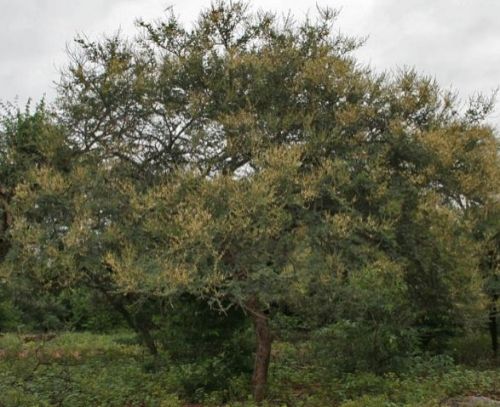
Acacia ferruginea, a medium sized drought resistant tree, is native to India and Sri Lanka and grows to a maximum 12 m tall and up to 1.0m in girth. It is Vulnerable A1c ver 2.3 in IUCN red list category. In India the tree is commonly found in Gujarat and parts of Andhra Pradesh and is moderately common in the Deccan, Maharashtra, Karnataka and the eastern slopes of the Western Ghats. The twigs are wiry and glabrous, being reddish or green in colour, while the primary roots are long and thin. The bi pinnate leaves are 5.0 - 7.5cm long, infra-stipular and the flowers are yellowish with d-ense spikes. The glabrous pods filled with a sweetish pulp, measure 7-18 x 2-2.5 cm and are dark brown in color. Acacia ferruginea seeds measure 0.5-0.7 x 0.35-0.5 cm, and are oblong and flat ovate, being greenish or brownish in color. In the Indian subcontinent, flowers appear between the months of March and May, and pods ripen between November and February. Acacia ferruginea prefers heavy red soils and is also tolerant to shallow stony surfaces drought tolerant.
Synonyms : Albizia procera (Roxb.) Benth., Acacia procera (Roxb.) Willd., Mimosa elata Roxb., Mimosa procera Roxb.
Leucaena leucocephala deep rooted high yielding perennial tree, withstands repeated defoliation, can be managed at any height. Green yield 50-60 MT/ha/Yr.


Tamarindus indica a moderate sized to large, evergreen tree, up to 24-30mt. in height and 7 m in girth, but generally smaller, cultivated or found naturalized almost throughout the plains and sub-Himalayan tracts of India, particularly in the South. Bark brownish or dark grey, longitudinally and horizontally fissured; leaves paripinnate, up to 15cm long; leaflets generally 10-20 pairs, sub-sessile, oblong, 8-30mm x 5-10mm; flowered racemes at the ends of rthe branchlets; pods 7.5-20.0cm long, c. 2.5cm broad and 1.0cm. thick, more or less constricted between the seeds, slightly curved, brownish-ash-coloured, scurfy; seeds 3-12, obovate-oblong, compressed, with a shallow, oblong pit on each side of the flat faces c. 1.5x0.8cm in loculi, enveloped by a tough, leathery membrane, the so-called endocarp.
Outside the endocarp is the lightbrownish, red, sweetish acidic, edible pulp, traversed by a number of branched, ligneous strands. The outermost covering of the pod is fragile and easily separable. The tree has usually a short and thick trunk, with is seldom straight. It has a handsome, dense and spreading crown of feathery foliage and is prized for ornament and for palnting on the roadsides for shade. Through it is evergreen, there is abundant leaf-fall and the new leaves appear during March-April. In very dry localities, it sometimes becomes leafless for a short time during the hot season. The flowers appear from April to June and the pods ripen in the cold season. The tree is not exacting as regards the soil and in place it has become naturalized even in rocky land. It, however, thriges best on the deep alluvium. The tree generall prefers a warm climate and can withstand drough, but is sensitive to frost
Acrocarpus fraxinifolius is a lofty, deciduous, buttressed tree, up to 60m in height and 8.1m in girth, with a clear bole of 18-45m. The tree is found in the lower hill-forests of the eastern Himalayas, extending to Nagaland and Manipur, and in the evergreen hill-forests of South India. Bark is fairly smooth, greyish brown, and leaves are bipinnate with 30cm or more long rachis.
Acrocarpus fraxinifolius commonly known as Pink cedar is one of the largest and fast growing timber trees in India thriving in areas of heavy rainfall. It is commonly found in the evergreen forests of the Western ghats, mostly on the hill slopes (up to 1, 200m), in Sikkim and in Duars of West Bengal and Assam. The tree is now also cultivated on a large scale in Coorg and South Kanara districts of Karnataka. Acrocarpus fraxinifolius is also grown as a shade-tree for coffee in Coorg, and has been recommended for tea plantations. It can be grown in areas unsuitable for teak. The tree is sensitive to frost but the seedlings are not browsed by animals.
Under natural conditions Acrocarpus fraxinifolius seeds germinate with the onset of monsoon and the young seedlings can be collected for the nursery. The tree flowers in South India from November to January and the fruits ripen during April-June. Though the pods are collected when they turn black, from February till the onset of the rains, the best seeds are obtained only during April-May. The pods are dried in the sun for 3-4 days on mats and beaten with stick to shell the seeds. About 46, 000 seeds weigh to a kilogram. Acrocarpus fraxinifolius seeds cannot be stored for more than 10 months. The seeds, sown immedietaly after collection, show 30-40 per cent germination in 10 days. Successful germination requires soaking in concentrated sulphuric acid for about 10 min or in warm water for 14hrs. For direct sowings, the seeds are placed 1.8m apart or may be broadcast in burnt fuel-coupes.
In recent practices, the seed are mixed with those of Chuckrasia tabularis A.Juss.or Toona ciliata M.Roem. Acrocarpus fraxinifolius are tolerant to shade and grow rapidly. Nursery beds are watered twice a day during germination period, and later every alternate day. The beds are weeded after germination. The seedlings are pricked out as they are sufficiently large for handling and transplanted in June of the same year. older plants can also be transplanted succesfully. Acrocarpus fraxinifolius susceptible to infestation by aquatic insects, such as Martesia spp. and Teredo spp. If infected by Trametes lactinea Berk and T. betulina Linn, sap wood turns white and spongy, while heartwood bomes. It is also infested by several beetles and larvae.
The sapwood is white , heartwood is light red with slightly darker lines. The wood is lustrous, without characteristics odour, fairly durable, moderately hard and strong heavy ornamental. Somewhat interlocked or wavy grained or with fiddle-back mottling, the wood is comparable to that of Chuckrasia spp. It is easy to saw, though nail-holding power is low. Chuckrasia tabularis wood is primarily used for shingles and plankings and for making tea-boxes in West Bengal. It is a general-utility timber, suitable for beams, rafters, trusses, doors, windows, etc. For doors and windows, it may be substituted for teak and sal after proper seasoning and preservative treatment. It is a general construction wood and is substituted for Poonspar wood (Calophyllum elatum). Being ornamental, it is also suitable for packing-cases for heavy machinery and other similar stores, tool helves and handles for shovels, rakes, and spades. It makes good veneers and plywood. Chuckrasia tabularis timber may be used for the productionn of second-class kraft pulp. The waste wood is used as fuel.
Ficus religiosa, commonly known as the Bodhi Tree or Peepal, is a large deciduous tree, growing up to 30 m in height, and trunk diameter of up to 3 m, at breast height. The tree is a native to the Indian Subcontinent, Indochina and south-west China. The bark is light gray in color, with peelings in patches. The leaves are leathery, green colored, slightly egg-shaped, pointed at the tip, and cordate at the base, measuring 4-8 inches in length and 3-5 inches in width. Being a monoecious tree, male and female flowers grow on the same tree. Ficus religiosa flowers are pollinated by fig wasps. Ficus religiosa seeds are very rare to to find and are highly prized. The tree is considered as sacred in Hindi and Buddhist cultures. Gautam Buddha is believed to have achieved enlightenment, while sitting under Ficus religiosa. In India, the tree is grown near temples and praying spaces at home.
Grevillea robusta, a native of Eastern Australia, is an evergreen tree with a long pyramidal crown, growing to a height of 12m. Leaves are alternate, 6-12 inches long, fern-like, deeply pinnatifid, dark green above and silvery below. Grevillea robusta flowers are orange-colored, solitary or several together, borne in 3-4 inches long racemes, on short leafless branches of old wood. The fruit is an oblique, coriaceous follicle, containing 1 or 2 seeds. Grevillea robusta seeds are black in color, and measure 2 cm in length. Grevillea robusta wood in rot resistant, and is used for making furniture, fences and cabinets.
Common Name : Silkcotton Tree, Malabar Semul , Indian bombax , Kapok tree , Silk Cotton. , Red Cotton Tree , Red silk cotton tree
Synonyms : Bombax ceiba Linn. syn. Bombax malabaricum DC.; Salmalia malabarica (DC.) Schoot & Endl.; Gossampius malabarica (DC.) Merrill, Salmalia malabarica

Terminalia catappa is alarge, handsome, deciduous tree, 32mt. tall having a bole of 12m, with a smooth grey bark and whorled branches, found in the Andamans. It is also cultivated in gardens for edible frits. Stems somewhat buttressed at the base, fluted slightly above; leaves large, obovate, usually crowded at the end of the branchlets; flowers white, star-shaped, in slender racemes; drupes yellowish or reddish, ellipsoidal, distinctly compressed, endocarp, enclosing the edible seed.The tree is common in the Andamans in the beach forest ofn the raised sandy beaches and extends into the forests behind where it is confined to sandy or shingly soils.
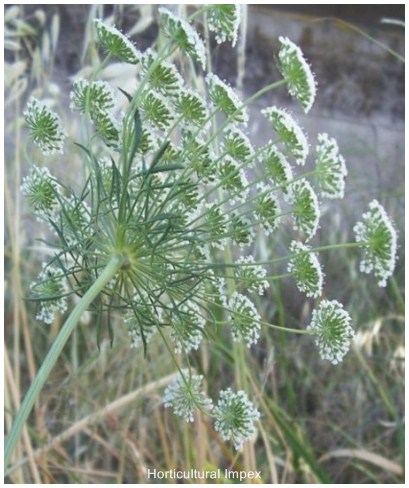
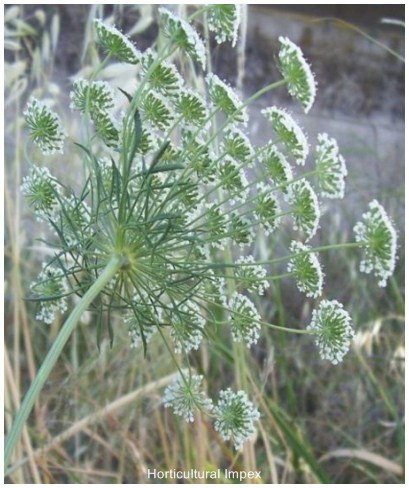
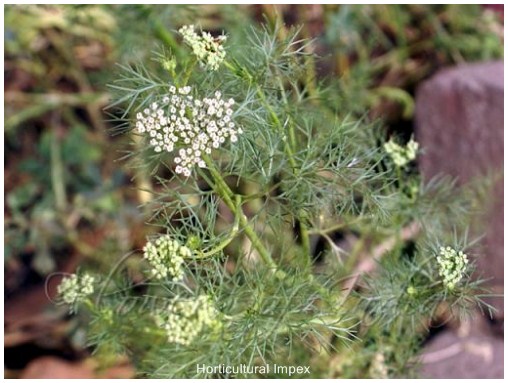
Trachyspermum ammi an erect, glabrous or minutely pubescent, branced annual, up to 0.4-0.6mt. tall, cultivated almost throughout India. Stands straight; leaves rather distant, 2 - 3 - pinnately divided, segments linear, ultimate segments 1.0 - 2.5cm long; flowers in terminal or seemingly - lateral pedunculate, compound umbles, white, small; fruits ovoid, muricate, aromatic cremocarps, 2-3mm long, greyish brown; mericarps compressed, with distinct ridges and tubercular surface, 1 - seeded.
Nelumbo nucifera a handsome aquatic herb with stout, creeping rhizome found throughout India, ascending up to 1800 m. Leaves peltate, 60-90 cm. or more in diam., orbicular, glaucous; petioles very long, smooth or with small prickles; flowers solitary, large, top-shaped 5-10 cm in diam., spongy, with many (10 -30) uniovulate carpels sunk separately in cavities on the upper side; carpels maturing into ovoid nut like achenes.
The guar gum obtained from the plant, has gained huge importance due to its utilization in the extraction of oil shale gas. India and Pakistan are major exporters of Cyamopsis tetragonoloba, and account for over 80% of the global production. Moreover, the herb is also utilized for human consumption across Western and Southern India, while the foliage is high on protein content, and is thus, used as fodder. It is also grown for gum production. Seed flour is used to improve paper strength.
The herb is an annual legume and is rotationally planted, with maize or wheat, to increase the soil quality. The fast growing root system facilitates its growth in semi-arid and arid regions. The trifoliate leaves measure 5-10 cm in length, have white hairs, and are elongated and oval and shape. Cyamopsis tetragonoloba flowers are pink, white or gray in color, and the pods are hairy, straight and pale green, bearing 5- 12 seeds upto 10cm long. The tiny, oval shaped Cyamopsis tetragonoloba seeds are used as fodder, and in petroleum, paper, and mining industries. It is drought resistant.
Albizia lebbeck or Woman's Tongue Tree, a medium-sized deciduous tree, grows up to a height of 30 m, with a large and spreading crown, up to 30 m across. The tree is a native to Indo-Malasia and northern Australia, and was later successfully introduced in India. The bark is rough, gray and flaky, and stems are grayish-brown. Albizia lebbeck leaves are bipinnate, with upto 5 pinnae across a 8-9 cm long rachis. The 5-10cm long rachilla bears 3-11 pairs of leaflets, which are oblong or asymmetric. Fragrant flowers are present in terminal or axillary semi-globular clusters of 15-40 flowers. Albizia lebbeck flowers are creamy-white in color, with pale green tip, and turn dark yellow with age. The indehiscent Pods are glabrous and measure 12-35 cm in length, and 3 - 6 cm in width. Pods are yellowish-brown in color and contain 3-12 seeds. Albizia lebbeck seeds are brown-colored, ellipsoidal and flattened, and require less pretreatment for successful germination. Albizia lebbeck is drought tolerant and thrives well in a wide range of soils. The tree is a good soil binder a is frequently used for soil erosion control, along with the other uses a source of hardwood and forage.
Delonix regia a strikingly ornamental medium-sized tree, planted in avenues and gardens in all the warmer and damper parts of India.This plants attains a height of 40ft. It has a spreading crown of feathery foliage, which are alternately arranged, bipinnately compound, entire, semi-evergreen, green in colour and bears flowers early in the hot season as the foliage falls and the branches are nearly bare. The flowers with panicles, varying in colour from deep crimson through scarlet orange to delicate salmon, appear in profusion in broad erect clusters along the branches, presenting a gorgeous appreances. The flowers last till June or even longer. Gumohar is naturalized in India and is widely cultivated as a street tree.
Acacia mangium is a very fast growing plantation species, which can attain 15m height and 40cm in 3 years and 23m height in 10 years. Solid wood yield varies with levels of 46mt./ha/yr, and is occasionally attained. The wood is hard, pale yellow with narrow sapwood and close grain. Mature trees are about 35mt. in height and up to 60cm in diameter. The bole is generally straight and matures with-in 12 years. Flowers are white or cream coloured. Acacia mangium seeds are shiny black and small. Juvenile foliage resembles that of Leucaena, Albizzia and other mimosoid legumes.
Dalbergia latifolia, commonly known as East Indian rosewood, is a large deciduous or nearly evergreen tree with cylindrical, fairly straight bole and fully rounded crown. The tree grows to a height of 20-40 m, and to a girth of 1.5-2 m, at breast height. Dalbergia latifolia is found in sub-Himalayan tracts of eastern Uttar Pradesh, Bihar, Orissa, along with many areas of central, western and southern India. The pinnate leaves are alternately arranged, and contain about 5-7 dark green and blunt-tipped leaflets of unequal sizes. Dalbergia latifolia flowers white colored, and are arranged in 0.5-1 cm long corymbose panicles, across leaf axils. The brown colored, oblong-lancelike pods are indehiscent, and contain about 1-4 seeds. Dalbergia latifolia seeds are reniform, smooth and brown colored. The tree is widely cultivated for its durable and highly priced heavy wood, as it is closed grained strong, durable, ornamental, often utilized to make premium furniture and decorative items. Dalbergia latifolia wood is in high demand across the globe, and export of lumber produced from wildly growing trees is abolished under the Indian constitution. It is also used to make agricultural implements. The species name Latifolia means broad-leaved. This plant is drought resistant.
Common Name : Blackwood, Bombay blackwood, rosewood, Roseta rosewood, East Indian rosewood, black rosewood, Indian palisandre, and Java palisandre
Dalbergia sissoo, commonly known as Indian Rosewood or Shisham, is a deciduous tree, with light crown. Under favorable conditions the tree attains a height of about 25mt., a girth up to 8ft and a clear bole up to 35 ft. The tree is native to India, and is internationally known for its premium rosewood timber. The leaves measure about 2-4 inches in length, and are odd-pinnately compound, alternate and orbiculate or elliptic (oval) in shape. Dalbergia sissoo flowers are white, cream or grayish-pink in color, measure about 3 cm in length, and are placed in dense clusters, measuring 5-10 cm in length. The fruits are indehiscent, measure 5-7.5cm in length and 8-13mm in width, rounded in bean shaped light brown colored, and contain 1-5 seeds. Dalbergia sissoo seeds are flat, kidney-shaped, light brown and thin, measuring 8-10 mm in length. The tree generally grows across river beds, and has a long taproot. Dalbergia sissoo wood is is used for making furniture, musical instruments, cabinets, agricultural tools, skis and boats. The wood is a premium veneer material, and is also used as fuel, due to its high calorie content.

Common Name : Australian wattle, coast wattle, Darwin black wattle, earleaf acacia, earpod black wattle, earpod wattle, Japanese acacia, nothern black wattle, Papua wattle, tan wattle, wattle
Acacia auriculiformis, a straight, medium-sized tree, up to 15-30m in height, with slightly angular branchlets, is a native to Australia and was later introduced into the semi-arid regions of India Bihar, Orissa and West Bengal and other countries. The Bark is white, smooth and somewhat fissured, leaves are pinnate, rachis is modified into a phyllode, and the fragrant flowers range from white to rich yellow. The pods are coiled and open-up on maturity to reveal the black Acacia auriculiformis seeds, which hang on strings of yellow aril to attract birds. Acacia auriculiformis wood is used for making paper and furniture, and the plant also bears analgesic properties.


Dodonaea viscosa is a cosmopolitan, variable, evergren shrub or a small tree, occurrring almost throughout India. This plant attains height of about 1-3mt, but rarely can reach upto 10mt. The leaves are simple elliptical, 6-13 cm long and 2-4 cm broad, and secrete a resinous substance. The flowers are yellow to orange-red, produced in short racemes. The fruit is a capsule 2 cm broad, red ripening brown, with three wings. It is found gregariously in western Himalayas as undergrowth in Pinus roxburghii Sarg forests and in dry miscellaneous forests ascending to 6, 500 ft. It is also found in the drier regions of south India up to an altitude of about 8, 000 ft. It regenerates profusely by seed and is useful species for reclothing denuded tracts.
The Acacia Holosericea seeds are native to Australia. But they have found more usage in areas like India and Africa where there is less water in some places. This tree helps in many ways like providing fuel, charcoal, animal fodder and for the rehabilitation of deforested land that has been abused due to mining and afforestation. Its nitrogen-fixing ability has made it a very much accepted tree for land that has become fallow due to over-cultivation.
You can trust Horticultural Impex to supply you with seeds that are extremely good quality-wise. Our quality has turned us into the nation’s only destination as Acacia Seeds Manufacturers of repute. Our seeds have stood the test of time and have become the best quality mature trees.
Quercus incana a moderate-sized to large evergreen tree, up to 25m high and 3.0m girth, found in Kashmir and the western Himalayan regions up to Nepal at altitudes of 1000-2400m and occasionally decending into moist situations of Kangra and Kulu. Bark grey to greyish brown, silvery when young, peeling off in rounded flakes; leaves oblong or ovate-lanceolate, with white or grey tomentum bneath; male spikes densely hairy and clustered, female flowers usually sessile; acorns single or in pairs; net ovoid, brown with a grey pubescence near the apex.
Swietenia mahagoni a medium to large, magnificent , evergreen tree, native to Central America, with a handsome spreading habit. It has a buttressed base and, in its native country, the tree reaches a height of 30 m and a girth of 4.5 m., but in India it attains a height of 18-24 m only. Bark rugose grey-black; leaves paripinnate; leaflets 2-4 parirs, 3-5cm. long, opposite, very oblique, often subfalcate, lanceolate or ovate; flowers greenish yellow, in axillary pendulous panicles, shorter than the leaves; capsules ovoid, about 7.5 - 15.0 cm. x 7.5cm; seeds many, flat, winged.
Manilkara hexandra A small to medium-sized evergreen tree with a spreading crown and straight massive bole, found in central India and the Deccan Peninsula; it is cultivated throughout the greater part of India for ornament and also for the sweet edible fruit. Bark dark grey, deeply furrowed; leaves elliptic-obvate or oblong, coriaceous; flowers solitary or in fascicles, white or pale yellow; berry ovoid or ellipsoid, c. 1.5 - 2.0 cm. long, reddish yellow; seed 1, rarely 2, ovoid, 1.0 - 1.5 cm. long, reddish brown, shining.
 Mr. Harsh Kumar (Horticultural Impex)
 05, Panditwari, PO, Prem Nagar, Dehradun, Uttarakhand - 248007, India
 Share us via