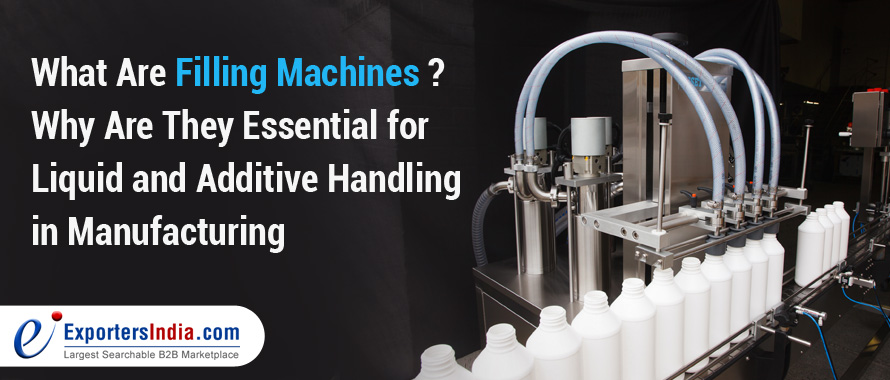
Filling machines are specialized machines that are used to fill liquids, powders, additives, or other substances properly and accurately, filled into containers. These machines are important in contemporary manufacturing as they have the capacity to dispense the correct amount of product when required, and they are also able to produce at the required speed and hygienic standards at the same time. The filling machines find wide application in many industries such as food and beverage, pharmaceuticals, cosmetics, chemicals and plastics to automate and streamline the packaging process to minimize manual labour and minimize waste.
Types of Filling Machines
Depending on the products that are processed during manufacturing, filling machines are of different types:
Liquid Filling Machines
These are meant to be used on a wide variety of liquids, such as watery liquids like water and juice, all the way to thicker liquids such as oils and syrups. They are flexible in terms of accommodating different viscosities and can be adjusted to suit certain product needs in order to fill them precisely.
Powder Filling Machines
Powder Filling Machines fill dry materials, mostly powders, granules, and additives, into the appropriate containers in a controlled manner.
Semi-Automatic and Fully Automatic Machines
Semi-automatic machines and Automatic Filling Machine involve some amount of manual intervention in feeding or capping, making them suitable either on a small to medium production level, but fully automatic machines do not involve human intervention and can be used on large-scale production lines.
Different Filling Machines
These different Filling Machines are made to operate special substances like corrosive liquid, volatile chemicals, or sterile pharmaceuticals, and which adhere to strict rules of safety and cleanliness.
Influential Characteristics of Filling Machines
The filling machines made today have some of the important features that render them indispensable in the manufacturing process:
- Accuracy and Precision: These machines provide a steady volume of fills, will means that there will be uniformity of products, hence avoiding over-filling and under-filling of products that may make customers dissatisfied or unwarranted legal actions.
- Speed and Efficiency: Huge production rates will enable the manufacturers to comply with huge orders and still have minimal downtime, enhancing the overall efficiency of operations.
- Hygiene and Safety: Made to high sanitary standards, filling machines will minimize interactions of humans with products and reduce the risk of contamination, and may have convenient cleaning and sterilizing options.
- Flexibility: Most filling machines are constructed to allow all types of containers, sizes, and materials so that the manufacturers can respond quickly to various packaging requirements.
The Reason behind the necessity of Filling Machines in the manufacturing process
Modern manufacturing processes cannot do without filling machines due to several reasons:
- Cost Reduction: These machines save costs both in terms of wastage of materials, given that the automation of the filling process eliminates the need of using manual labor, which saves costs in the long run.
- Quality Assurance: Filling machines ensure the consistency of the product by dispensing and receiving the material in an accurate way, and the consistency of the batches must be maintained by this method, which is essential in the integrity of the brand and compliance with the regulations.
- Improved Productivity: Filling machines have a large capacity to produce goods, and they operate at high speeds with minimum downtime, something that allows manufacturers to produce more and satisfy the needs of the market.
- Conformity to Standards: Filling machinery is required to meet a lot of standards in the safety and hygiene of most industries, which is achieved through specific and contamination-free filling processes.
- Flexibility: The machines are capable of processing a broad assortment of product types, viscosities, and container formats. This provides manufacturers with the flexibility to move through product lines very fast.
Filling Machines Uses in Different Industries
There are widespread uses of filling machines in most industries that need to fill liquids and additives with high levels of precision and hygiene:
Food and Beverage Industry
Bottling machines are applied in the filling of fruit juices, sauces, edible oils, dairy products and carbonated drinks. They also make sure that every bottle or container is filled with the required quantity and there will be no spillage or contamination of the products. The packaging of perishable liquids under hygienic conditions is also done using advanced machines to increase shelf life.
Pharmaceutical Industry
These are used in the filling of the liquid pharmaceuticals, syrups, vaccines, and sterile pharmaceuticals. It is important to maintain accuracy and hygiene in this to ensure that the dose is correct and to avoid contamination, to ensure adherence to the strict health rules. Injectable drugs are put in specialized sterile filling systems to maintain sterility.
Cosmetics & Personal Care Industry
Creams, lotions, shampoos, conditioners, and perfumes are filled by the use of machines. Since the viscosities of products are quite varied, with some being quite liquid, such as lotions, and others exceedingly thick, such as creams, machines are tailored to make these products fill without ruining the delicate texture, but without still changing the volumes. Also, hygiene characteristics guard against microbial contamination.
Chemical Industry
Filler machines have been used in the dispensing of chemical detergents and cleaning agents used in industry, paints and solvents, which are often corrosive or hazardous liquids that can be safely and accurately dispensed with the help of a filling machine. Engineering and special materials guarantee the long-lasting nature of a machine and the safety of its operators.
Plastic & Additive Manufacturing
Dosage of liquid additives, colorants, and plasticizers is an important factor in ensuring that there are no negative impacts on the quality of the products during the plastic molding and extrusion analysis. Filling machines can be used to uniformly mix by dispensing the accurate amounts of required additives into raw materials.
Advantages of Filling Machines
The utilization of filling machines is associated with a wide range of benefits that make the manufacturing processes much better:
- Enhanced Accuracy and Wastage: The accuracy of dosing offered by filling machines is very high and thus greatly reduces the chances of overfilling or underfilling containers. This precision lowers the wastage of raw materials, reduces expenses, and enables consumers to have the same quantity of products each time.
- Increased Production rate: With automated filling technology, it has an extremely high throughput, and a large volume of product may be produced in a very short period by the manufacturer. This has been assisting in delivering against strict deadlines, seasonal demand peaks and distribution in high quantities at a significant level.
- Improved Product Hygiene and Safety: Automated systems lessen direct contact between humans, which can reduce risks of contamination, which is more important in food, pharmaceutical, and cosmetic sectors. Most types of filling machines are engineered to work under a cleanroom environment and can easily be cleaned and this makes them comply with high hygienic standards.
- Cost Efficiency: Filling machines are also cost-effective by eliminating the need for manual labor, decreasing product spillage and minimizing packaging anomalies. More cost savings are motivated by energy-efficient models, as well as minimal maintenance features.
- Adaptability and Versatility: Modern filling equipment is able to take in an immense variety of types (bottles, jars, tubes, pouches) and sizes of containers and an immense variety of products with different viscosities and chemical properties. This is because with this flexibility, manufacturers can respond fast to the changes in the markets and releases without necessarily retooling as much.
- Better Quality Control: Filling is stable and enhances customer satisfaction and brand loyalty through a similar experience of the product. It also helps the producers to comply with the regulatory provisions of labeling, dosage and packaging provisions.
- Increased Operational Safety: Special equipment is used to process dangerous, corrosive, or volatile liquids in a risk-free fashion and the operators do not come in contact with the materials and are these materials and the integrity of the process is not put at risk.
Conclusion
The filling machines are relevant in the industry since they are efficient, precise, and hygienic in handling liquids and additives. They apply to a variety of industries and the value added by them, such as cost reduction, increasing the production rate, accurate dosing and increased product safety, is considered a valuable investment towards competitive and high-quality production.