Write a Review
Our Products
Our Complete range of products are Automatic Night Lamp Cum Emergency Light and Automatic Emergency Light.
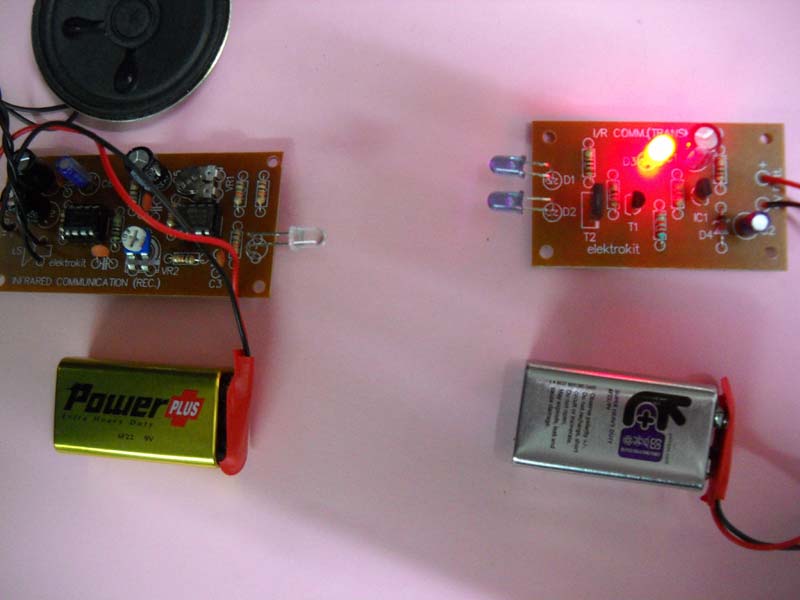
Sensing darkness and LED light in the room with battery backup and available for Rs 390/-, the Automatic Night Lamp Cum Emergency Light uses a light-dependent resistor (LDR) as the sunlight sensor and a total of 9 high-brightness white LEDs. Separate resistors are connected in series with each row of the LEDs.
The working of the circuit is very simple. During daytime, light falls on the LDR1 and it offers a low resistance. As a result, both the transistors (T1 and T2) do not conduct and the LEDs (D1 through D9) do not glow. On the other hand, during nighttime, the light does not fall on LDR1 and it offers a high resistance. As a result, transistors T1 and T2 conduct and the LEDs (D1 through D9) glow.
Assemble the circuit on a PCB and enclose in a cabinet. Connect the LEDs (D1 through LEDD9) and LDR1 on top of the box and place the unit such that during daytime the sunlight falls directly on LDR1. For powering the circuit, use a 9V battery & 9-0-9V/500mA transformer. The power supply rectifier diode D11 & D12 & filter capacitor C2 is already in the circuit.VR1 for adjusting the light intensity for LDR.
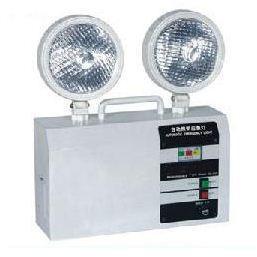
Automatic Emergency Light is an automatic emergency lamp with day light sensing. This Automatic Emergency Light senses darkness/night and turns ON automatically. Similarly, the Automatic Emergency Light senses day light and turns OFF automatically. Here, lamp is use a batch of light emitting diode (white LED), and its sufficient light for emergency purpose.
About The Circuit :As shown in the circuit diagram, AC input is given through transformer. The transformer rating depends on the output DC voltage as shown in the table. The AC output voltage obtained from the transformer, is rectified through bridge rectifier designed using four diodes D1 to D4. Capacitors C1 is used to filter the AC signal. The rectified filtered output is given to diode D6& D7 for reverse current protection. When the light level is low the resistance of the LDR is high. This prevents current from flowing to the base of the transistors. Consequently the LED does not light. LDRs or Light Dependent Resistors are very useful especially in light/dark sensor circuits. Normally the resistance of an LDR is very high, sometimes as high as 1000 000 ohms, but when they are illuminated with light resistance drops dramatically.VR1 is used for sensitivity of LDR adjustment.VR2 can control the reference voltage adjustment. The 5mm LDR is just mounted on top of the emergency light. LDR is used to avoid it lighting up during day time or when the room lights are ON. However, when light shines onto the LDR its resistance falls and current flows into the base of the first transistor and then the second transistor. The LED D5 is indicates DC power ON from mains. The DC power to charge the 9V battery through D6 & D7. When mains supply is off, the current flows the circuit through 9V battery and lights illuminated. 2 LEDs are used in series; the dropping resistance (R9, 10, 11) and 2 LEDs light up with small current that is required for a single LED, by which energy is saved to a great extent.
 Dilip Bhoyar (Elektrokit)
 Keshav Imperial,Shop Nop B-101,B Wing First Floor,Nagpur, , Shani Mandir, Near Shani Mandir, Sitabuldi, Nagpur-440012, Maharashtra, India, Shankar Nagar
 Share us via