Write a Review
Our Products
Our product range contains a wide range of Fan Speed Remote Control
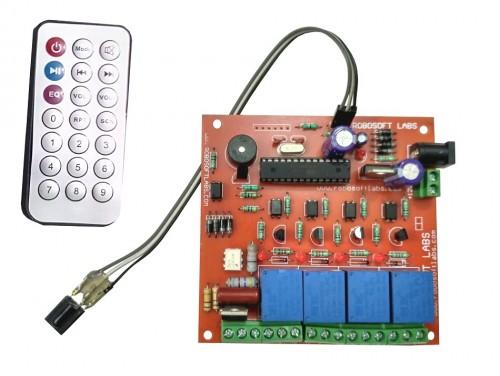
In today’s era of technological advancements, remote operated devices become very common in our life. Speed Control Of Fan Using Remote Control is designed to help control the speed of fan in five steps using remote Speed Control Of Fan Using Remote Control can be used to control the power output of lamp or induction motor. The main advantage is that the circuit is free from ambient light interference and provides control range at about 25 feet without the use of any focusing lens.
About the Circuit :The circuit comprises transmitter and receiver section as shown in the circuit diagram. The transmitter section consists of an oscillator and an output stage, whereas the receiver section consists of an infrared detector module, time delay circuit with noise filter, bistable flip-flop and an output relay section. The detailed description of each section is given below.
Transmitter Section :The transmitter is built around IC3, which is wired in astable mode. When switch is pressed, the circuit gets energized and generates output with a center frequency of about 25 KHz. The infrared LED D11 connected at its output transmits infrared beams modulated at the same frequency (25 KHz). The oscillator frequency can be shifted slightly by adjusting preset.
Receiver Section :The receiver uses an infrared sensor module for sensing the infrared signals from the transmitter section. When switch S1 on the transmitter is pressed, the infrared LED radiate infrared beams with modulating frequency of 25 KHz. The infrared signal from the transmitter is sensed by the sensor and output at pin2 goes low. This in turn switches on transistor T1, consequently provides clock input to IC1 and its output at pin3 goes high. This results in forward biasing of transistor T2, T3, T4, and T5, which on conduction energizes relay RL1, RL2, RL3, RL4 and RL5 respectively. The output of IC1 is also used for lighting LEDs indicating the presence of signal. When ON signal is available output of the sensor module goes high and T1 is switched off.
When another signal arrives after about 300ms, IC1 gets another clock pulse and get the output of pin2 of IC1 and at the last the output come to the pin10 but it reset through diode if another pulse arrives from the transmitter before a delay of about 300ms with respect to previous transistor. T1 again turns on and voltage across capacitor C1 cannot fall below VL (the maximum input voltage required to sense a logical low by IC1). Hence, the output of IC1 does not change, as there was no low to high transition. This feature prevents false triggering due to switch bouncing and other such reasons. The same resistor, capacitor network provides immunity against infrared noise from other sources.
This is explained below :The solid-state triac dimmer TR1 is used by varying the resistance value controlled by the relay. The circuit operates on the phase-controlled principle. The main control is provided by preset P1. This determines the rate at which C12 reaches the breakdown voltage of the diac, which is when the triac is triggered resistance in conjunction with relay and C12 alternatively may be used as a fine brightness control.
The DC power supply using the step down transformer 0-12V using the step down capacitor C11 as a filter. The regulator 7805 to reduce and regulate the voltage of the circuit.
 Dilip Bhoyar (Elektrokit)
 Keshav Imperial,Shop Nop B-101,B Wing First Floor,Nagpur, , Shani Mandir, Near Shani Mandir, Sitabuldi, Nagpur-440012, Maharashtra, India, Shankar Nagar
 Share us via