Write a Review
Our Products
We are leaders in the market for providing best range of Heart-Beat Monitor and Temperature Monitor
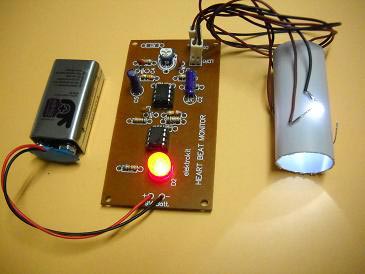
See the heart rate pulses on LED by sensing blood flow through fingertip using the Heart-Beat Monitor. The Heart-Beat Monitor is the answer to questions like, How could anyone expect an ordinary light dependent resistor photo cell to 'see' through a fingertip in LED Light and detect the change in blood flow as the heart pulsates? The secret is a high gain circuit, based on a dual op amp IC which can be either the low power CA3140. The LDR is connected in series across the 9V battery supply via a 100kOhms resistor (R2) and VR1 the minute signal used by the blood pulsing under the skin is fed to the non-inverting (+) input, pin 3, of IC1a via a 0.1µF capacitor. Pin 3 is biased by a high impedance voltage divider consisting of two 3.3M Ohms resistors. The feedback resistors to pin 2 set the gain to 11 times. The output of IC1a is fed via a 0.47µF capacitor and 220k Ohms resistor to IC2. This is configured as an inverting op amp with a gain of 45 so that the total circuit gain is about 500. The output of IC2 is used to drive an a LED
Note that the unit is designed to use the good quality light dependent resistor (LDR.) Other LDRs may require a change in the value of resistor R1& VR1. A light source such as a high brightness LED is required. All that is needed is a reasonably well-lit room, preferably natural daylight, to produce a healthy emit LED. Only when the hands are very cold does it make it a little more difficult to accurately count the pulses. To check your heart rate, carefully position your thumb or finger over the LDR and count the LED fluctuations for a period of 15 seconds. Then multiply the result by four to obtain your pulse rate. The circuit cannot be used if you are walking or running, etc.
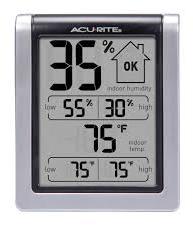
The Temperature Monitor is a miniature temperature controller device up to 100oC. This simple circuit of temperature monitor uses differential amplifier IC and temperature sensor. The three different colors of LED indications are used to indicate different temperatures. The temperature at which LEDs will glow set by preset P1. Generally LED D1 will glow at normal temperature. As the temperature increases LED D2 glows. At highest temperature LED D3 glows.
About the Circuit :
 Dilip Bhoyar (Elektrokit)
 Keshav Imperial,Shop Nop B-101,B Wing First Floor,Nagpur, , Shani Mandir, Near Shani Mandir, Sitabuldi, Nagpur-440012, Maharashtra, India, Shankar Nagar
 Share us via