
 GST : 09AZTPS6778B1ZI
 Write a Review
Our Products
We offer the best product range of Basil Oil, Citronella Oil, Palmarosa Oil, Fenugreek Oil and Capsicum Oleoresin.

Description- Basil oil is an annual herb, known as Ocimum basilicum, belongs to Lamiaceae family. It is originated from Tropical Asia and Pacific Islands, commonly cultivated in Europe, Central Asia, India and Southeast Asia. It grows up to 1 meter, its flower from white to pink. Basil essential oil is a source of Vitamin A, Magnesium, Potassium, Iron and Calcium. Basil oil used for various medicinal purposes.
Extraction- Basil oil is extracted from leaves and flowers of Ocimum basilicum through steam distillation.
Composition- Its major constituents are linalool, fenchol, eugenol, methyl chavicol (Estragole) and β-caryophyllene and other minor constituents are α-pinene, camphene, β-pinene, myrcene, limonene, cis-ocimene, γ-terpineol, citronella, geraniol and methyl cinnamate.
Properties – Basil oil is a pale greenish yellow and clear in colour and watery in viscosity. Its aroma is crispy, light.
Blending- Basil oil is well mixes with bergamot, lemon, juniper, eucalyptus, neroli, lavender, clove bud, geranium, Melissa, lime, hyssop, marjoram and rosemary.
Uses-
Safety and Precaution- Do not use in excessive amount as it may be carcinogenic due to its methyl clavicol content.Avoid use of basil oil while pregnant or breast feeding.Keep basil oil away from reach of children.It can cause low blood sugar in some people.Do not use people who are suffering from bleeding disorder.
Specification of Basil Oil:
Botanical Source – Ocimum basillicum Description – Pale yellow colour clear liquid, characteristics odour. Pleasant smell. Acidity – Complies Solubility – Soluble in ethanol (70%)
Physio –Chemical Properties:-
Optical Rotation – 8° – -1° Wt. /ml (gms/lit.) – 0.930 – 0.946 Refractive Index – 1.500 – 1.509 Assay by GC – NLT 70% Methyl Chavicol content Storage Condition – Store in well closed container, in cool and dark storage area.

Description: Citronella plant is known as Cymbapogon plant, belongs to lemongrass family. Citronella oil can be derived from two varieties such as Ceylon variety, botanical known as Cymbopogon nardus while other one is Java variety, scientifically termed as Cymbopogon wintarianus. It grows in Asian countries and also in South Pacific. Due to its rich, crispy lemony aroma, it bears citronella name.
Extraction: Citronella oil is obtained from fresh plant of Cymbopogon through steam distillation method.
Composition; Its main constituents are citronella, geraniol, citronellol, citronellyl acetate, beta-bourbonene, geranyl acetate, elemol, L-borneol, linalool and nerol.
Properties: Citronella oil is slight yellow and colorless in color. It has grassy and lemon scent.
Blending: Citronella oil is well blends with other essential oils such as cedar wood, clary sage, tea tree, eucalyptus, geranium, lavender, lemon, peppermint and rosemary.
Uses:
Safety and Precautions: Avoid using citronella while pregnant as it can cause mild skin irritation.It can cause irritation, dermatitis or sensitization of skin.
Specification of Citronella Oil:
Organoleptic Properties:
Appearance – Fluid liquid Colour – Light yellow Odour – Strong odour of citronella. Botanical Source – Cymbopogon Winterianus Jowitt
Physico Chemical Properties:
Specific Gravity – 0.840 – 0.900 Optical Rotation – +4° – -2° Refractive Index – 1.445 – 1.478 Solubility – Soluble in 0.8 to 1.5 vol. of 80% alcohol Storage – In well fitted container in cool and dark place.


Description:
Fenugreek is an annual herb scientifically known as Trigonella foenum belongs to Fabaceae family, native to the Mediterranean regions, Southern Europe and Western Asia. Fenugreek seeds are rhomboid shaped, it has small round leaves that can be dried, as well as seeds. Fenugreek leaves consisting of small, obviate to oblong leaflets, widely produced in Afghanistan, Pakistan, India, Iran, Nepal, Bangladesh, Argentina, Egypt, France, Turkey, Morocco and Spain.
Extraction:
Fenugreek oil is derived from seeds of fenugreek herb through steam distillation.
Properties:
Fenugreek oil is yellowish with a hint of brown colour. Its aroma is fragrant with tones of bitter. Fenugreek seed essential oil contains volatile compounds.
Composition:
Fenugreek oil contains various nutrients are: omega –cardinene, alpha- cadinol, gamma-eudesmol and alpha bisabolol.
Uses:
Safety and Precaution:
Use carefully, Fenugreek oil can affect blood sugar levels in people with diabetes as it is hypoglycemic.
Avoid using fenugreek oil as it can cause early contraction and also may cause unusual body odor.

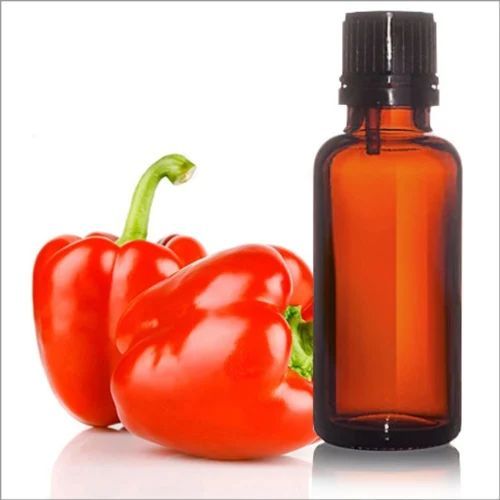
Description- Capsicum Oleoresin is derived from chili peppers, Capsicum Annum Linn, belongs to Solanceae family, it contain red coloring matter called Capsanthin, a powerful irritant. Capsicum is perennial shrub and its fruit berries may be green, yellow or red in colour. Its native region is America and well grown in sunny positions with warm, loamy soil.
Extraction- Capsicum oleoresin is extracted from crushed capsicum with volatile solvent by percolation method or by solvent extraction method.
Properties- Capsicum oleoresin have characteristic pungent in smell, dark red in colour and slight bitter in taste. Capsicum oleoresin is concentrated liquid.
Composition- It is composed of capsaicin, dihydocapsaicin and nordihydrocapsaicin.
Uses-
Safety and Precaution-
Specification of Capsicum Oleoresin
Appearance – Red and brown mobile extract.
USP Capsaicin RS Identification (TLC) – As per standard
Assay by GC
Total Capsaicinoids Test – NLT 8.0% Nonivamide – max. 5% Water – max. 8.0% on 5 gm.
MICROBIAL QUALITY Total plate count – less than 1000cells/gram Yeast and Mould – less than 100cells/gram E.coli – Negative/5 grams Storage – In well-fitted container in cool and dark place.

Description: Cypress oil is acquired from cypress tree, scientifically known as Cupressus sempervirens belongs to Cupressaceae family. Cypress oil is fresh and herbaceous in aroma. Cypress is a deciduous tree and has dark green foliage, small flowers and round brown gray cones with seeds nut. It is well grown in wetlands and it is native to South Western US Mountains and Northern Mexico. It is widely cultivated in Spain, France and Morocco.
Extraction: Cypress essential oil is obtained from bark of cypress tree through steam distillation method. Cypress oil is pure and organic by steam distillation and if it is extracted by solvent extraction or supercritical carbon dioxide then it does not remain organic.
Properties: Cypress oil is greenish or yellowish in appearance and has fresh and herbaceous aroma and slightly evergreen and woody scent that promote calming and healthy & full of energy feel.
Blending: Cypress is well mixes with other woody oils like cedar wood and pine oil and other essential oils such as lavender, rosemary and citrus oils like bergamot, frankincense, juniper berry oil, lime, lemon, orange, and grapefruit.
Uses:
Safety and Precautions: Avoid cypress oil during pregnancy.Do not use Arizona cypress oil as it contains toxic ketone which can attack mucous membrane.

Description: Bay is an evergreen tree, scientifically known as Pimento racemosa, it is native to South America. Bay tree grows up to 30 feet in height, small and erect in structure. It has grayish bark, aromatic and green leaves, also bear berries. It has long pointed leaves, with small yellow or white flowers with black berries.
Extraction: The Bay oil is acquired from the dried leaves and berries which are collected or harvested from 5 years old bay tree through steam distillation. Either added salt or seawater is required in distill for extraction of bay oil.
Properties: Bay oil is a warming oil, deep golden yellow to brown in colour; strong spicy smell similar to clove and watery viscosity. Its aroma is fruity, spice and herbaceous.
Composition: Main constituents of Bay oil are eugenol, chavicol, myrcene, linalool and limonene.
Blending: Bay oil is nicely blends with cedar wood, coriander, eucalyptus, geranium, ginger, juniper, lavender, lemon, orange, rose, rosemary, thyme and ylang ylang.
Uses:
Safety and Precautions: Need guidance of an aromatherapy practioner as it can cause skin irritation due to its eugenol component.Avoid use of bay oil during pregnancy or nursing women.People who are suffering from kidney, liver diseases, cancer and who are using anticoagulants should avoid use of bay oil as it can cause harmKeep away from reach of children and infants.
Specification of Bay Oil:
Botanical Source – Bay Oil Description – Pale yellow coloured fluid liquid. Odour – Strong, pleasant, fruity and exciting spicy odour. Refractive Index – 1.500- 1.545 Optical Rotation – -3° – +3° Specific Gravity – 0.9 40 – 0.988 Storage – In well fitted container in cool and dark place

Description- Tea tree is scientifically known as Melaleuca alternifolia, belongs to Myrataceae or myrtle family. Tea tree plant is indigenous to Southeast and Northeast Coast of New South Wales, Australia, also cultivated in New Zealand. It is an attractive thin leafed plant with soft; fine branch lets and it can grow fast and harvested as early as 6 months.
Extraction- Tea tree oil is a volatile essential oil is derived mainly from Melaleuca alternifolia tree leaves, twigs and terminal branches through steam distillation method, although there are various extract methods such as distillation, Carbon dioxide supercritical extraction and solvent extraction.
Composition- It is composed of 100 compounds, its main composition are Terpene hydrocarbon, monoterpenes & other alcohols.
Properties- Tea tree oil is an essential oil having fresh and spicy camphoraceous odor and light yellow to early colorless and clear in appearance. Its aroma is warm.
Blending- Tea tree oil is nicely blends with basil, bergamot, black pepper, chamomile, german, clary sage, cypress, eucalyptus, geranium, juniper, lavender, marjoram, lemon, thyme, ylang ylang, oregano, peppermint, pine, ravensara, rosemary, and oakmosss.
Uses-
Safety and Precaution-

Description: Patchouli oil is acquired from evergreen perennial, scientifically known as Pogostemon patchouli and it belongs to Labitae. Patchouli oil is native to Southeast Asia, commonly cultivated in India, Indonesia, Philippines, China and Malaysia. It is bushy herb of the mint family with erect stems, grows up to 2 or 3 feet and bearing small, pale pink-white flowers.
Extraction: Patchouli oil is obtained from leaves and white, violet marked flowers of the patchouli plant through steam distillation method.
Properties: Patchouli oil is thick in consistency, light yellow, deep golden or brown in colour and having sweet, strong earthy aroma.
Composition: Its major constituents are patchouli alcohol, alpha bulnesene, alpha-guaiene, seychellen, pogostrol, gamma-patchoulene and alpha patchoulene.
Blending: Patchouli oil is nicely blends with bergamot, clary sage, geranium, lavender and myrrh.
Uses:
Safety and Precaution:

Description- Rosemary is a herb used for aromatherapy as well as for culinary purpose, is known as Rosmarinus officinalis belongs to Lamaeceae family. Rosemary is evergreen plant which has grayish green, needle shaped leaves with slightly blue colour small flower. Rosemary plant is native to Mediterranean region, Asia and also cultivated in France, Tunisia and Yugoslavia.
Extraction- Rosemary oil is obtained from the flowering tips of Rosmarinus officinalis herb through steam distillation method.
Composition- Its constituents are α-pinene, β-pinene, borneol, camphor, bornyl acetate, camphene, 1-8 cineole, and limonene.
Properties- Rosemary oil is clear in colour, refreshing herbal smell, evergreen like scent and watery viscosity. It is volatile in nature.
Blending- Rosemary essential oil is particularly well blends with Frankincense, lavender, clary sage, cedar wood, basil, thyme, citronella, lemongrass, elemi, geranium, chamomile, peppermint and cardamom.
Uses-
Safety and Precaution- Rosemary oil should be avoided by pregnant or breast feeding or nursing women, excessive use of oil may lead to miscarriage or disability in fetus.Do not ingest as it can cause vomiting or spasm.
Specification Of Rosemary Oil
| Specification of Rosemary Oil | |||
| Organoleptic Properties:- | |||
| Appearance | Fluid liquid | ||
| Colour | Pale Yellow or almost Colorless | ||
| Odour |
The odour is strong, fresh, woody-herbaceous, somewhat minty-forest like odour. The fresh notes vanish quickly yielding to a clean woody-balsamic body note which tones out in a dry herbaceous but very pleasant & tenacious bitter-sweet note. | ||
| Botanical Source | Rosemarinus officinales Linn. ( Fam. Labitae) | ||
Physio-Chemical Properties
| Physio-Chemical Properties:- | ||
| STANDARD | ||
| Specific Gravity | 0.894-0.912 | |
| Refractive Index | 1.463 – 1.477 | |
| Optical Rotation -3° to +18° | ||
| Solubility | Soluble in Alcohol and other organic solvent and in soluble in water. | |
| Storage | In well fitted container in cool and dark place. | |

Description: Lemon grass oil is acquired from Cymbopogan citratus, belongs to grass family named as Poaceae; it is native to tropical and subtropical regions, it is medicinal herb of India and also cultivated in other parts such as Africa, Indonesia, Sri Lanka, China, Malaysia, Cambodia. Lemongrass plant grows well in dense clumps; it has bright green, sharp edged leaves. It grows up to 6 feet in height.
Extraction:Lemongrass oil is derived from leaves of the Cymbopogon plant through steam distillation.
Composition: Its main constituents are myrcene, citronella, geranyl acetate, nerol, geraniol, neral, limonene, terpineol, methyl heptenone, dipentene, farnesol and citral.
Properties: Lemongrass oil is light and has thin consistency with a pale or bright yellow in color and fresh lemony smell with earthy aroma.
Blending: Lemongrass oil is well mixes with other essential oils such as basil, cedar wood, coriander, geranium, jasmine, lavender and tea tree.
Uses:
Safety and Precautions:
Specification of Lemongrass Oil:
Organoleptic Properties:
Appearance—Fluid liquid Colour – Light yellow to pale yellow with reflection of reddish brown colour. Odour – The odour is strong, sharp, pungent & fresh-grassy lemon type, Herbaceous or Tea like odour. Botanical Source – Cymbopogon flexuous, Cymbopogon citrates (Fam: Gramineae)
Physico-Chemical Properties:
Specific Gravity – 0.892 – 0.925 Refractive Index – 1.481 – 1.492 Optical Rotation – -3° to +4° Assay by GC – Min. 70% Citral content Storage – In well fitted container in cool and dark place.
 Mr, Abhishek Sharma (Indian Farmer Land)
 I-44, Senior Citizen Complex, P-4, Omega, Gautam Budh Nagar, Greater Noida, Uttar Pradesh - 201310, India
 https://www.indianfarmerland.in
 Share us via