
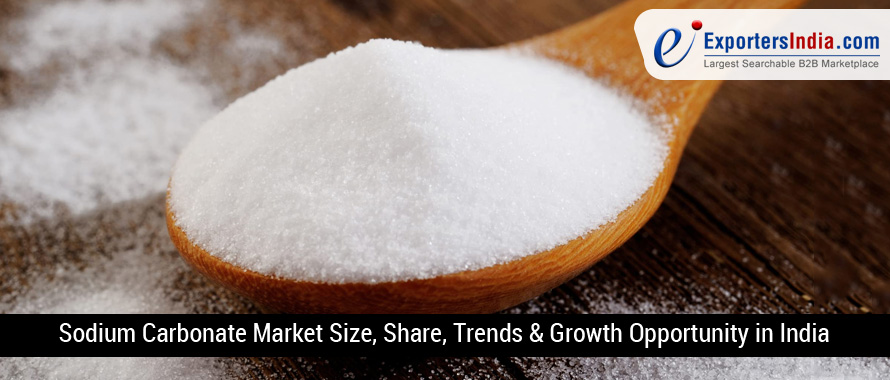
The soda ash (sodium carbonate) is a very valuable inorganic compound that can be used in various ways. Plus, this inorganic compound is an amorphous hygroscopic solid. And its solubility is highly soluble in water and other solvents. Its chemical formula is Na2CO3 and it works as a base as opposed to an acid.
Also, Sodium carbonate is essential in the glassmaking industry because it lowers the furnace melting temperature. Thus minimizing the cost of production. Naturally, it is formed by the plant ash rich in sodium or industrially by the Solvay Process, which is a mixture of limestone and sodium chloride. Sodium carbonate is not that toxic, but when taken long-term, it may cause irritation to the skin or eyes, and when taken orally, it may cause stomach discomfort, nausea, or vomiting. Plus, the Growing demand for sodium carbonate is also projected to fuel market expansion, and in this blog, let's have a keen look at these Driving Forces Behind the Sodium Carbonate Manufacturers' Market Expansion of Sodium Carbonate.
It is predicted that sodium carbonate manufacturers will experience substantial growth in the production of goods like soda-lime-silica glass, glass containers and flat glass in the forthcoming years. Being an important raw material in the glass industry, the demand is growing because of the increasing demand for flat glassware in the housing industry, the automotive industry and commercial construction projects as well as container glass in the consumer goods sector.
Outside of glass, sodium carbonate finds many uses in the food industry, chemical production, detergents, soaps, swimming pool maintenance, and personal care products. The increasing environmental awareness also adds more strength to its presence in the market, since it is applied to control alkalinity and is used to treat water systems. As demand grows in several industries, the market is expected to grow, but threats like substitutes and industry changes are likely to limit the growth.
The industry with the greatest demand for sodium carbonate is the glass industry. Which absorbs more than half of the world's demand. Soda ash is also critical in the production of soda-lime glass, which is used in construction, auto-part uses, and packaging. As housing and infrastructure booms are taking place in India. The production of automobile vehicles is increasing. This is why the demand for flat glass and container glass is also increasing.
The diversity of sodium carbonate is the main ingredient in various industries:
The increase in consumption in these applications, particularly in detergents and personal care has boosted consumption of the substance in India and even in Southeast Asia.
The use of sodium carbonate is widely used in the recycling of zinc and aluminum. It is also applied in ore processing to extract impurities of sulfur and phosphate. Plus, its role in the generation of a broad spectrum of chemical structures further highlights its industrial significance.
Demand has also been assisted by the growing environmental awareness. To correct the alkalinity of water bodies, neutralize acidic environments and stabilize high and low PH changes, sodium carbonate is employed, which can cause damage to aquatic ecosystems.
The sodium carbonate market is threatened by substitutes in spite of high demand. Other substitutes like recycled glass, aluminum and plastics are also widely used in packaging. Thereby minimizing the use of glass containers. Of special importance is the change by both the food and packaging industries to stop using glass.
Consumer trends are also another challenge. Liquid detergents are becoming popular at the expense of powdered detergents and the detergent industry. Which was a large consumer of soda ash, is suffering a drop in sales. This trend can restrain growth opportunities since soda ash is not commonly used in liquid formulations.
There are opportunities for increasing investments in the sodium carbonate market that are lucrative. Multinational players are just increasing production capacity in response to the increased demand in Asia. Moreover, there are further opportunities in the growth of the pharmaceutical industry since sodium carbonate is used in the production and processing of drugs.
The prospects of sodium carbonate producers are bright in the case of India. Where urbanization, industrialization, and healthcare demands grow at high rates.
The sodium carbonate market could be classified as natural and synthetic products. Synthetic products are predominant in India and the world in general because of the uncomplicated Solvay Process. This is advantageous because of the availability of raw materials such as limestone, brine and coke.
Whereas, the Synthetic sodium carbonate should continue to increase due to its affordability, scalability and flexibility in application to industries.
The highest end-user of sodium carbonate is glass production. The competition between the flat and container glass is increasing in India due to:
The flat glass business is especially important because it is a contributor to the burgeoning construction industry in the urbanizing areas.
The detergent powders continue to be a significant source of soda ash consumption, particularly among the developing economies. Soda ash remains important in detergent manufacturing in countries such as India. Where price is a determining factor. Although liquid detergents compete with them, this segment does not become irrelevant in the rural markets.
Soda ash is used in water treatment as it helps soften water and maintain the pH levels. It is also essential in the production of chemicals in the production of various sodium-based as well as carbonate-based compounds. The activities in these industries guarantee constant demand.
Sodium carbonate finds its uses in mining in the process of ores, as well as in the removal of impurities. It is applied in pulping processes in the manufacturing of paper products and helps in the manufacture of high-quality paper products in paper manufacturing. The industries are smaller in terms of volume than the detergents or glass-making industries, but they generate niche, stable demand.
The Asia Pacific region controls the international market of sodium carbonate, with India and China as the major consumers. The glass industry is propelled by rapid industrialization, urbanization and a boom in construction activities. The growth of the middle class and the strong growth of the GDP in India enhance the demand for residential and commercial housing projects. This necessitates the use of flat glass.
Although the growth in these areas is not significant when compared to the growth in Asia, the demand is stable. Due to the presence of construction, pharmaceuticals, and chemical industries. North America and the U.S., in particular, are still investing a lot in infrastructure ventures, and the flat glass needs more sodium carbonate.
The other emerging economies, not in Asia, also help to enlarge the market, although to a lesser degree than India and China.
In 2021, it was invested more than 100 million dollars were invested in the United States to grow sodium carbonate production. This highlights its role in building and glass industries. Throughout 2024-2025, the demand is still growing drastically. Plus, the investments are aimed at increasing capacity to serve the glass manufacturing and chemical industries.
Also, in China and the Asia-Pacific, especially in India the growth is even greater. The building industry is reaching record levels due to rapid urbanization, expanding infrastructure, and a growing middle-class population in India. It is projected that demand growth in the sodium carbonate market is 5 to 6 percent annually in 2025, with massive demand for flat and container glass in housing, commercial building, and motor vehicle applications.
This regional growth brings out the dual purpose of sodium carbonate, both as an essential industrial raw material and as a strategic commodity in addressing the construction and sustainability demands of the emerging economies.







Connect with us





