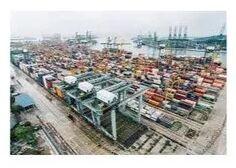
Acontainer portorcontainer terminalis a facility wherecargo containersaretransshippedbetweendifferent transport vehicles, for onward transportation. The transshipment may be betweencontainer shipsand land vehicles, for exampletrainsortrucks, in which case the terminal is described as a
maritime container port. Alternatively, the transshipment may be between land vehicles, typically between train and truck, in which case the terminal is described as an
inland container port.In November 1932, the first inland container port in the world was opened by thePennsylvania Railroadcompany inEnola, Pennsylvania.Port Newark-Elizabethon theNewark Bayin thePort of New York and New Jerseyis considered the worlds first maritime container port. On April 26, 1956, theIdeal Xwas rigged for an experiment to use standardized cargo containers that were stacked and then unloaded to a compatible truck chassis at Port Newark. The concept had been developed by the McLean Trucking Company. On August 15, 1962, thePort Authority of New York and New Jerseyopened the worlds first container port, Elizabeth Marine Terminal.Maritime container ports tend to be part of a largerport, and the biggest maritime container ports can be found situated around majorharbours. Inland container ports tend to be located in or near major cities, with good rail connections to maritime container ports.It is common for cargo that arrives to a container port in a single ship to be distributed over several modes of transportation for delivery to inland customers. According to a manager from thePort of Rotterdam, it may be fairly typical way for the cargo of a large 18, 000TEUcontainer ship to be distributed over 19 container trains (74 TEU each), 32 barges (97 TEU each) and 1, 560 trucks (1.6 TEU each, on average).The further container terminal, in April 2015, suchAPM TerminalMaasvlakte II, that adapts the advanced technology ofremotely-controlledSTSgantry cranesand conceptions ofsustainability, renewable energy, and zerocarbon dioxide emission.Both maritime and inland container ports usually provide storage facilities for both loaded and empty containers. Loaded containers are stored for relatively short periods, whilst waiting for onward transportation, whilst unloaded containers may be stored for longer periods awaiting their next use. Containers are normally stacked for storage, and the resulting stores are known as container stacks.In recent years methodological advances regarding container port operations have considerably improved, such ascontainer port design process. For a detailed description and a comprehensive list of references see, e.g., the operations research literature.
Tag:green, Green Company, IGBC-DCS, IGBC-DCS GREEN CONTAINER HANDLING TERMINAL, internationalgbc

 GST : 27AVZPS7816G1ZN
 4.3/5
4.3/5
 Mr. Ranjit (Six Sigma Quality International)
 108, First Floor, Mehta Chember Station Road, Vasai, Mumbai, Maharashtra - 401202, India
 Share us via